FREE UK delivery on orders of £200 or more

The benefits of exhibiting at trade shows, or at any trade fair or expo, are simple: the buyers in your sector are all in one hall for a few days, they have come to look at products like yours, and you can talk to them face to face. That makes a good show one of the fastest ways to generate qualified leads, launch a product, find distributors and see what competitors are doing.
It is not automatically worth it, though. Exhibiting pays when the show’s audience matches your buyers and you have a plan to follow up. Trade shows provide leads, brand awareness and face-to-face time with potential customers in one place, and they allow businesses of any size to compete for attention on the same show floor. Below are the reasons that genuinely justify the cost, the warning signs that a show is wrong for you, and a simple test for deciding.
Quick answer: benefits of trade show participation and how to measure each
| Reason | Best for | How to measure it |
|---|---|---|
| Meet qualified buyers in volume | B2B firms with a clear target sector | Qualified leads and meetings booked |
| Demonstrate the product in person | Physical, technical or high-value products | Demos given, quotes requested |
| Launch something new | New products, rebrands, new market entry | Launch enquiries, press coverage, feedback logged |
| Find distributors and partners | Manufacturers and brands expanding reach | Partner conversations and agreements started |
| See the market in one day | Anyone setting next year’s strategy | Competitor and pricing notes, trends logged |
| Build credibility in your sector | Newer or smaller brands | Return visitors, inbound enquiries after the show |
Reasons to exhibit at a trade show: 7 key benefits
1. Potential customers come to you
A trade-only show filters its audience for you. Visitors register with their company and job title and choose to spend a day in your sector, so a high share of the trade show attendees walking past are your target audience. Compare that with cold outreach or digital marketing, where most of the effort goes into finding the right person before the conversation even starts.
Meeting face-to-face also changes the quality of the conversation. The Association of Event Organisers reports that 87% of business directors agree it is easier to communicate face to face than on the phone or by email. You can read reactions, handle objections on the spot and agree a next step before the visitor walks away.
Decision rule: if you cannot name the job titles you want to meet, and confirm with the organiser that those people attend, this reason does not apply yet.
2. Visitors come to learn, so demonstrations win
Exhibitors and visitors attend for different reasons. A Cornell study of more than 2,500 exhibitors and attendees found exhibitors were mainly focused on business and contact development, while attendees were looking for a unique experience and were motivated heavily by educational goals.
That gap is an opportunity. If your product or service is easier to understand when people see it, touch it or watch it solve a problem, a trade show is one of the few channels where you can show it to dozens of prospects an hour. Plan the stand around a short, repeatable demo that every attendee can follow, and a clear answer to the question your buyers most often ask.
3. A ready-made stage for new products
Shows give a launch a date, an audience and press in the building. Trade journalists walk the trade show floor looking for news, and visitors expect to see new products. You also get unfiltered feedback in a few days, which is far quicker than waiting for a campaign to report back.
Do this: tell the organiser’s press team about the launch before the show, have samples or a working demo on the stand, and log every piece of feedback with the visitor’s details.
4. Business relationships with distributors, partners and a new supplier
Many visitors are not end buyers at all, and good trade shows attract business partners as well as customers. Distributors, resellers and potential partners use shows to find new lines. If business growth for you means new channels or new regions, a stand gives those people a reason to approach you rather than the other way round. Buyers also use shows to find a supplier, so a partnership conversation can start with either side. Shows are a fast way to build relationships that would take months of emails.
5. Market research and industry insights you cannot get online
Walking the hall shows you competitor launches, pricing, messaging and stand investment in one afternoon. Attend the talks by industry experts too: they show what the industry is worried about. Write it down on the day; it is easily forgotten once you are back at your desk.
6. Credibility and brand visibility in your sector
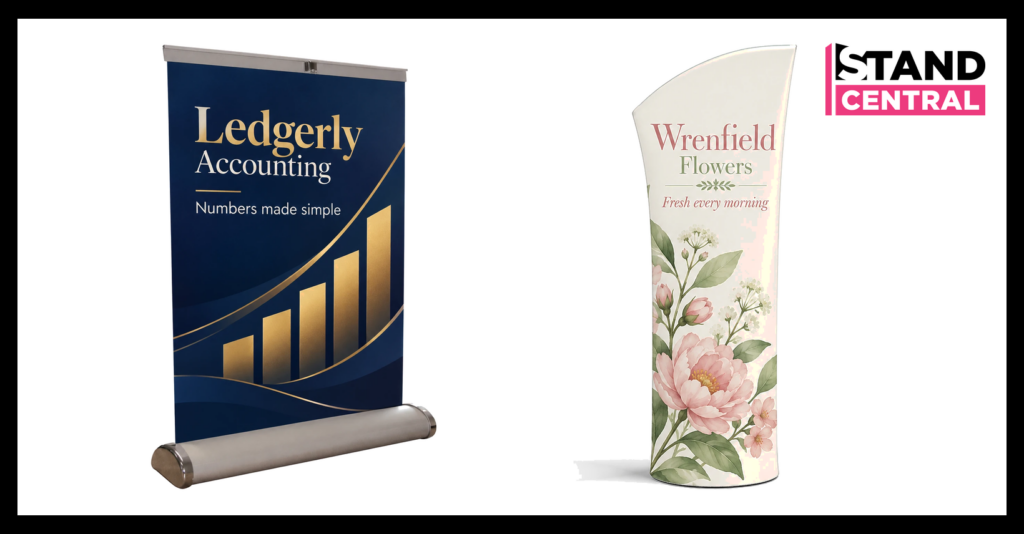
Being on the floor alongside the established names tells buyers you are serious and still trading. For newer or smaller companies this matters, and a well-designed small trade show booth can hold its own against much larger ones. A clear exhibition stand, a pull up banner or two and a counter make a professional trade show display without a custom build. Our guide to designing a stand that stands out covers how.
7. Time with existing customers
Shows are a cheap way to see many existing customers in person in one place. Invite them in advance, book meetings on the stand and use the time to cross-sell and gather testimonials. Potential clients who are close to buying often want to meet the team before signing, and a show gives them the chance.
When a trade show exhibit isn’t worth it
Skip or postpone a show if any of these apply:
- The organiser cannot or will not show you a visitor breakdown by sector and job title.
- Your buyers are a tiny niche that you can already reach directly and cheaply.
- Your budget only covers the floor space, with nothing for a stand, staff time or follow-up.
- Nobody will own the follow-up in the two weeks after the show.
- You have nothing new or demonstrable to show, and no specific goal beyond “being seen”.
Also check the price before you fall for the pitch. Only 46 of the 202 UK trade shows we checked published any price at all, so ask for the full rate card, including compulsory fees and power, in writing.
Is a trade show worth it? A simple break-even test
Work out how many new customers you need to cover the cost, then ask whether that is realistic for the audience.
- Add up the full cost. Space, stand and graphics, power, furniture, compulsory fees, travel, hotels and staff time. For scale: a 3m × 3m shell stand at Business Travel Show Europe cost £10,494 ex VAT plus £660 in compulsory fees, while the same size at Euro Bus Expo cost £2,889, both before anything else (source: our UK stand costs research).
- Know what a customer is worth. Use the gross profit from an average new customer in their first year, not revenue.
- Divide. Total cost divided by first-year gross profit per customer is the number of new customers you need to break even.
- Sense-check it. Use your normal conversion rate from qualified lead to customer to work out how many qualified leads that requires, then ask whether your team can hold that many proper conversations over the open days.
Here is an illustration, not a benchmark: if your all-in cost is £8,000 and an average new customer brings £2,000 of gross profit in year one, you need four new customers. If one in five qualified leads usually converts, you need around 20 qualified leads. If that looks achievable, the show is worth testing. If it needs hundreds, it probably isn’t.
Reusable equipment changes the sums over time. A stand you can take to several shows spreads its cost across all of them. The full budget breakdown is in our trade show booth cost.
How to have a successful trade show event
- Set one primary goal (qualified leads, meetings or launch enquiries) and a target number before you book.
- Book meetings before the show. Email customers and prospects your stand number and offer a time slot.
- Design for three seconds. Visitors decide from the aisle. One clear message about what you do and who it is for beats a wall of text.
- Staff with people who can answer technical questions, not just sales staff, and brief everyone on how to qualify a lead.
- Capture leads properly, with notes on what each person needs. Our trade show lead capture explain how.
- Follow up within days, while the conversation is still fresh.
For the full plan, use our step-by-step guide on how to prepare for a trade show, and for ideas beyond the stand itself, see how to stand out at a trade show. When you are ready to kit out the stand, browse our exhibition stands, portable exhibition stands and pull up banners. FREE artwork design or proofing on every order.
Frequently asked questions
What are the benefits of exhibiting at a trade show?
Access to many qualified buyers in a few days, face-to-face conversations that move deals forward, a stage for product launches, contact with distributors and partners, and first-hand market intelligence. The benefits are greatest when the show’s audience closely matches your customers.
Is exhibiting at a trade show worth it for a small business?
It can be, if you pick a show where your buyers are concentrated and keep costs under control. A small, well-designed stand with a clear message and a focused goal often performs better than a large, unfocused one. Run the break-even test above before you book.
How much does it cost to exhibit at a trade show in the UK?
Space alone ranged from £125 to £1,100 per m² ex VAT across the 26 headline space-only rate cards in our research, and you then add the stand, power, fees, travel and staff. See how much trade show stands cost for a full budget.
How do you measure the return on investment of a trade show?
Track ROI through qualified leads, meetings booked and the sales they produce over the following months, then compare the gross profit with the full cost of exhibiting. Tag every lead with the show name in your CRM so the sales can be traced back.
Why exhibit rather than just attend trade shows?
Attending trade events lets you learn and network; as an exhibitor, the buyers come to you. A stand gives visitors a place to find you, see the product and leave their details, which turns a show from research into lead generation. If you are new to shows, our guide to what a trade show is and how it works explains the basics.