FREE UK delivery on orders of £200 or more
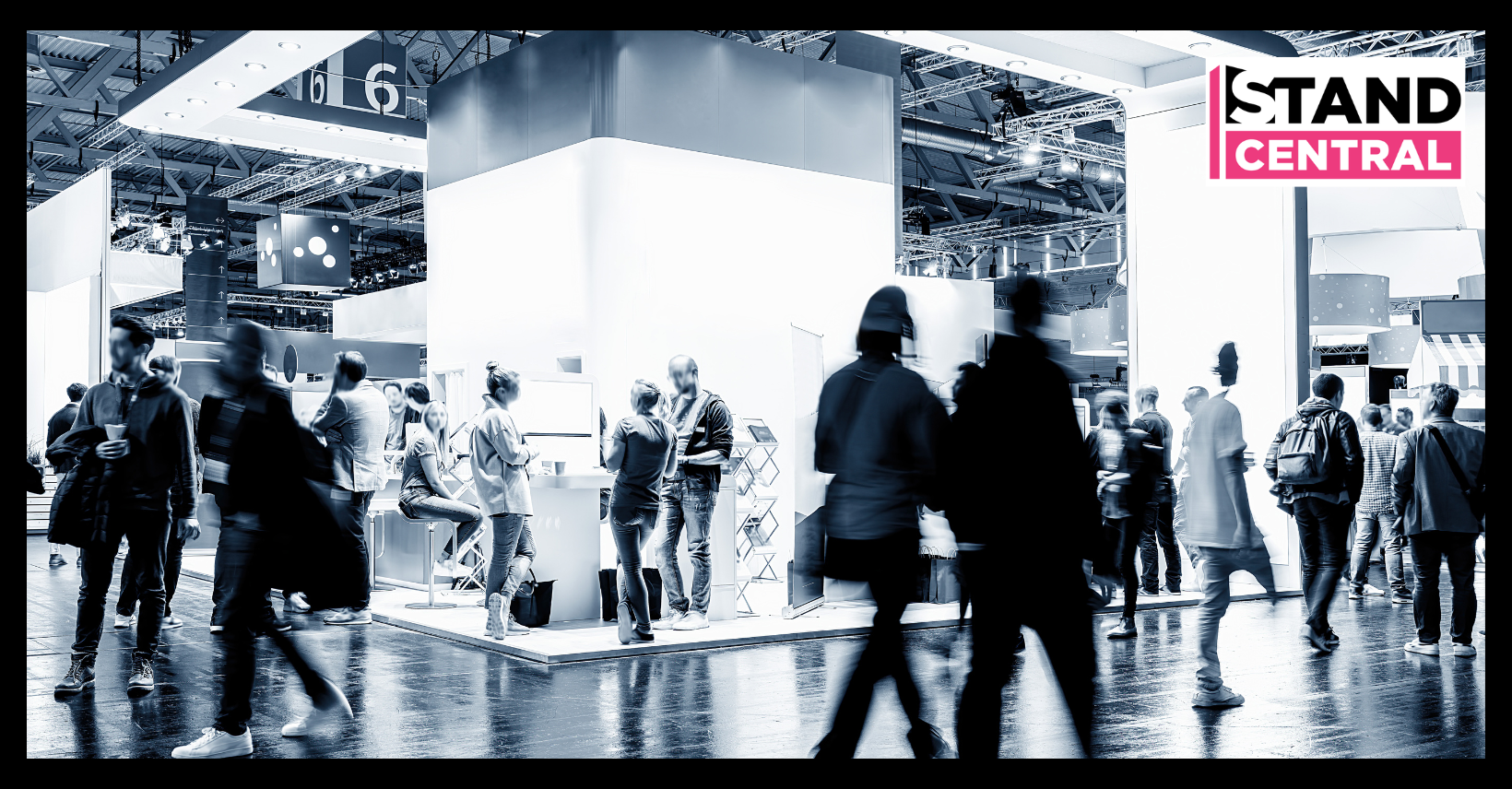
Designing a trade show booth comes down to one idea: design from the aisle inwards. A visitor walking past gives your booth a glance, so it has to say who you are and why it matters before they reach the next stand. That means one short headline high on the back wall, a clear order of graphics below it, an open front, light on the things you want seen, and colours that print the way your brand looks on screen.
The steps below follow the order the decisions are made at most trade shows. For ways to stand out through your team rather than the booth itself, read how to stand out at a trade show.
Quick answer: trade show booth design tips
| Design decision | Rule of thumb |
|---|---|
| Headline | One line, high on the back wall, saying what you do for the visitor. Logo next to it, not instead of it. |
| Graphic hierarchy | Three levels only: headline, three supporting points or one strong image, then detail at hand height. |
| Viewing distance | Test every graphic at the distance it will be read from: across the hall, from the aisle, and on the stand. |
| Layout | Keep the front open. Put the counter to one side, never across the entrance. |
| Height | Use the full wall height, and add a hanging banner or tall display if you need to be found from across the hall. |
| Lighting | Light the headline and the product. Check whether power is included before you design anything that plugs in. |
| Colour | High contrast between text and background. Ask for a proof on the actual material. |
| Material | Fabric for large walls that travel well; roller banners for low-cost supporting messages. |
1. Know the types of trade show booths before you design
Before any artwork, confirm three things from the exhibitor manual or booking form: the booth type, the exact floor footprint in metres and the height limit. They decide everything else. Most UK trade shows sell space in multiples of a 3m x 2m or 3m x 3m grid.
- Shell scheme: the organiser supplies the walls, usually with a fascia name board. Your job is graphics that fit those panels and anything freestanding you bring. Our shell scheme stand design guide covers panel graphics in detail.
- Space only: you get bare floor and build everything yourself, so you control the height, layout and lighting, but you also need every wall.
- Open sides: an inline booth is open on one side, a corner booth on two, a peninsula on three and an island booth on four. Every open side is a side someone approaches from, so it needs its own reason to stop.
Draw the booth to scale, mark the aisles and face your headline towards the busiest approach, which is not always the front of the plot.
2. Booth designs that work: a three-level graphic hierarchy
Most booth designs fail because everything is the same size, so nothing gets read. Give your graphics a strict order:
- Level 1, the headline: your product or service, in the visitor’s words, in one line. “Payroll software for UK care homes” beats a slogan. Put it in the top third of the back wall, above the heads of people standing on your booth.
- Level 2, the proof: one large product display image or up to three short benefits, at eye level.
- Level 3, the detail: specifications, prices, case studies and a QR code, at hand height on the counter, a brochure holder or a screen.
If your logo is the biggest thing on the wall and people do not already know your brand, the wall is working for you, not the visitor. Make the headline the biggest element and let the logo sit beside it.
3. Design for viewing distances, then test them
Every graphic is read from a particular distance, so design each one for where it will be seen from:
| Where it is read from | What it should carry | Typical items |
|---|---|---|
| Across the hall | Brand name or one word that identifies you | Hanging banner, top of a tall wall, lightbox |
| From the aisle | The headline and one image | Back wall, side wall, roller banner at the open edge |
| On the stand | Detail, prices, QR codes, small print | Counter front and top, brochures, screen, tablecloth |
Do not guess whether text is big enough. Print the headline at full size, or tape a full-size section to a wall, then walk past it at a normal pace from the far side of the aisle. If you cannot read it in the time it takes to pass, cut words or make it bigger. Keep text off the bottom of tall walls: once people stand on the booth, anything at knee height disappears behind them.
4. Plan the booth layout so visitors walk in
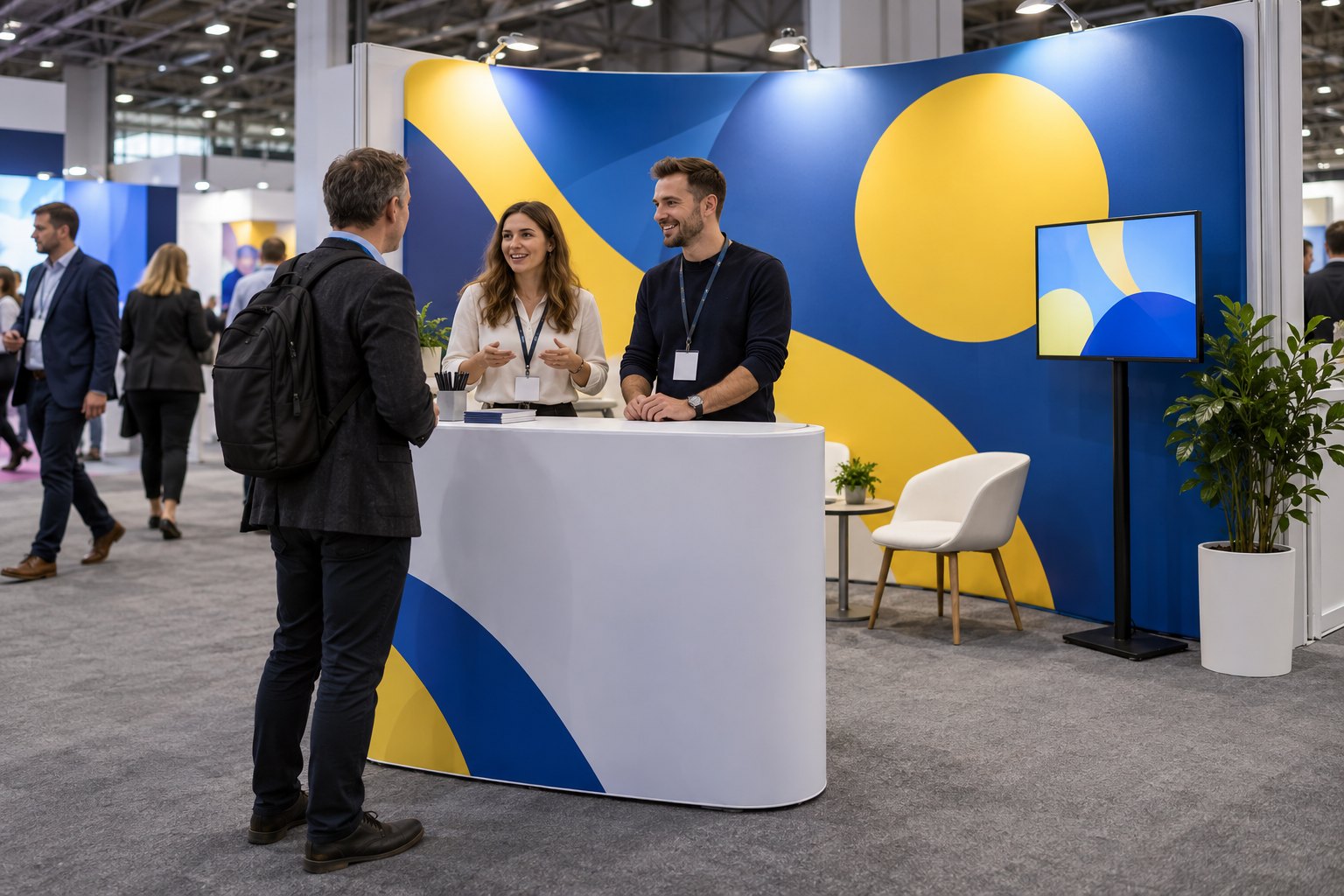
A booth only works if visitors feel able to step onto it. The commonest mistake is a counter across the front with booth staff lined up behind it, which turns the booth into a shop till.
- Keep the front edge open. Put the counter at a front corner, angled towards the main approach, so staff can greet people without blocking them.
- One zone per goal. Give product demos a point near the aisle where people can watch, and give conversations a quieter area at the back. Large booths can add a small meeting room.
- Clear the floor. Boxes, coats and spare stock go behind a wall, never in view. If you have no store, choose one of the exhibition counters with internal shelving.
- Furniture earns its place. On a 3m x 3m booth, a counter, one display and two stools is usually the limit before it feels crowded.
On a corner booth, turn the counter to face the corner so both aisles can see someone is ready to talk.
5. Use height to attract visitors from across the hall
At a busy expo the aisle is full of people, so anything below head height is hidden from anyone more than a few metres away.
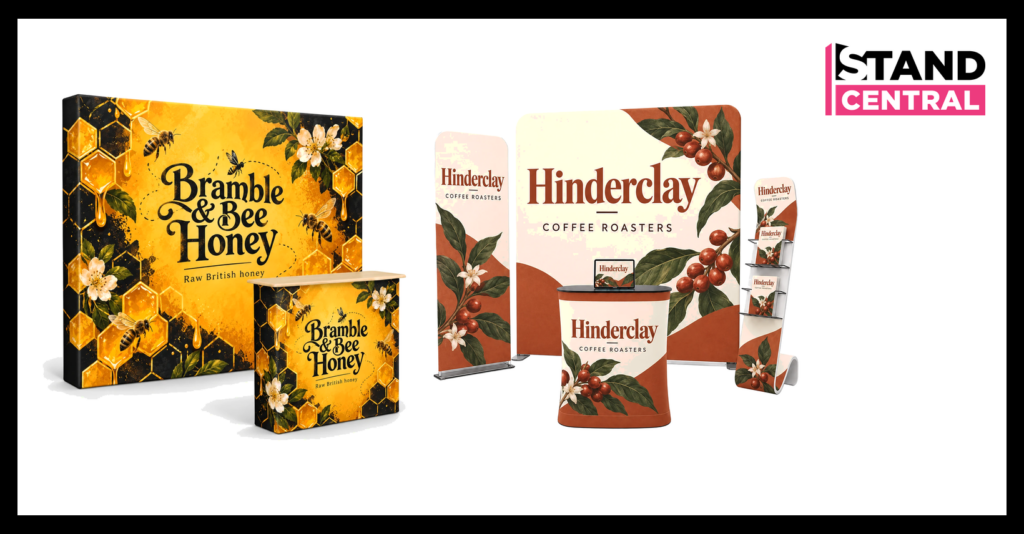
- Use the full wall height. Our 3m Soft Touch fabric display is 2,320mm tall, so your name and headline at the top stay visible over the crowds at busy trade shows.
- Hanging signs are the strongest way to mark your position, but they need the organiser’s permission and the venue’s rigging service. Excel London, for example, requires permission to rig from the event organiser. Our hanging banners start from £401.95 ex VAT for the frame and printed fabric; the rigging itself is booked through the venue.
- Check the height limit before you choose a tall trade show display or overhead signage.
6. Plan trade show lighting around what matters
Lighting makes your headline readable in a dim exhibit hall and pulls the eye to the product. Backlit graphics give the most consistent result because the light is built in: our LED lightboxes start from £258.95 ex VAT for a 2000mm x 850mm single-sided backlight box. A spotlight on a fabric wall is the cheaper alternative.
Check power before you design anything that plugs in. In our study of UK trade show rate cards, 26 shell scheme rate cards listed what they include: 7 included power, 4 listed it as an extra and 15 did not mention it (checked 28 September 2026). Order sockets early.
7. Choose colours that carry your brand
- Contrast first. Dark text on a light background, or light on dark, with nothing busy behind the words.
- Fewer colours. One main brand colour as a large block and one accent.
- Ask for a proof. The same artwork can look different on stretch fabric, banner film and backlit fabric. FREE artwork design or proofing on every order.
- Match everything. Booth, staff clothing, brochures and promotional items should look like the same company. That consistency is what builds brand awareness.
8. Fabric vs PVC and banner film
Booth graphics are printed either onto stretch fabric or onto a film that many people call PVC. Here is how the two compare, using products we supply:
| Fabric (dye-sublimation) | Banner film (roller banners) | |
|---|---|---|
| Example | Soft Touch 3m straight fabric display | Mantis 850mm roller banner |
| Graphic | 260gsm stretch polyester, dye-sublimation print | Grey-backed block-out media, UV printed, anti-glare finish |
| Size | 2,950mm wide × 2,320mm tall | 850mm wide × 2,000mm tall |
| Care | Machine washable at 30°C, crease-free look on the frame | Rolls back into its base |
| Fire rating | DIN4102 B1 | Listed as fire rated |
| Transport | Padded bag, 6.5kg shipping weight | Padded carry bag |
| Price | From £388.95 ex VAT | From £70.95 ex VAT |
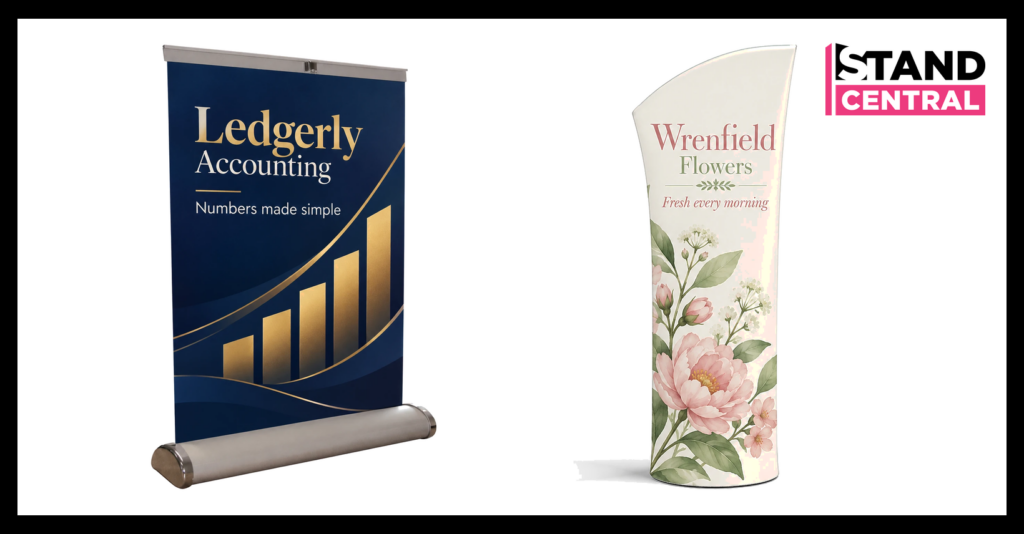
Use fabric for large back walls: one print without joins looks better and folds into a bag between trade shows. Use roller banners for supporting messages or a second language. Check the fire-rating requirement in the manual either way.
Booth ideas on a small budget
Good booth designs for trade shows on a small budget follow the same rules as big ones. A good booth does not need a custom trade show booth built from scratch. Portable booths built from a fabric back wall, a counter and one slim display cover most 3m x 3m spaces, and modular kits let you go big at one show and scale down at the next. A 3m fabric back wall had a median price of £399.00 ex VAT across 13 like-for-like walls from 7 UK suppliers (Stand Central inclusions research, captured 28 September 2026). Browse fabric display walls or the wider range of exhibition stands, and see our trade show booth cost guide for space and extras.
How to set up a trade show booth on the day
- Walk the plot with your plan and check the socket positions.
- Build the back wall, then the side walls. Graphics go on last, after the frames are square.
- Fit lighting and run cables before furniture goes in. Test everything that plugs in.
- Place the counter, displays and any screen. Keep the front clear and hide every box.
- Walk into the aisle and approach from each direction. Can you read the headline at walking pace? Fix it now, not after the doors open.
Photograph the finished trade show exhibit from the aisle as a reference for future trade shows; it also makes teardown easier.
Frequently asked questions
How do you design a trade show booth step by step?
Confirm the booth type, footprint and height limit; write a one-line headline; plan three levels of graphics; keep the front open; add height and lighting; then proof the artwork and test the headline at walking pace.
How far in advance should you start planning a trade show booth?
For trade shows, start as soon as the space is booked. Your planning timeline is set by the organiser’s deadlines for power, rigging and graphics approval, so read the manual first and work back from the earliest one.
Should you rent or buy a trade show booth?
If you exhibit at more than two trade shows a year, buying a reusable booth usually costs less per show. We also offer exhibition stand hire in England, so you can compare a hire quote with our purchase price for the same specification.
How do I make my trade show booth stand out?
A short headline high on the wall, strong contrast, lighting and height. Your team and pre-show promotion matter just as much.
How can you measure the success of your trade show booth?
At most trade shows, count conversations and qualified leads, not just footfall. Set a target, record each lead and compare the booth cost with the business that follows.