FREE UK delivery on orders of £200 or more


When you compare shell scheme vs space only, the short answer is this. A shell scheme is a ready-built stand with walls that the event organiser puts up for you, so you only bring graphics, a counter and a banner. Space-only is an empty floor area, so you bring the whole stand, its lighting and flooring, and you send plans to the show first. For a small stand the shell is usually simpler and often cheaper, and for a larger stand or one with open sides, space only gives you the freedom to build what you want.
Below I go through what each option includes, what it costs according to our own research, and which stands from our range suit each one. Product prices are live Stand Central prices, ex VAT, checked on 24 October 2026. Show rates come from our space only stand cost study of 202 UK trade shows, captured on 28 September 2026.
The difference between shell scheme and space-only stands at a glance
| Shell scheme | Space only | |
|---|---|---|
| Walls | Supplied by the show | You bring your own stand |
| Name on the front | Usually a fascia board | On your own graphics |
| Power | Included at 7 of 26 shows | Always ordered separately |
| Paperwork | Fascia wording by a deadline | Scale drawings and a risk assessment |
| Layout | Your graphics inside fixed walls | Any layout, up to three open sides |
| Best for | Small stands, first shows | Larger stands, more design freedom |
What a shell scheme exhibition stand includes
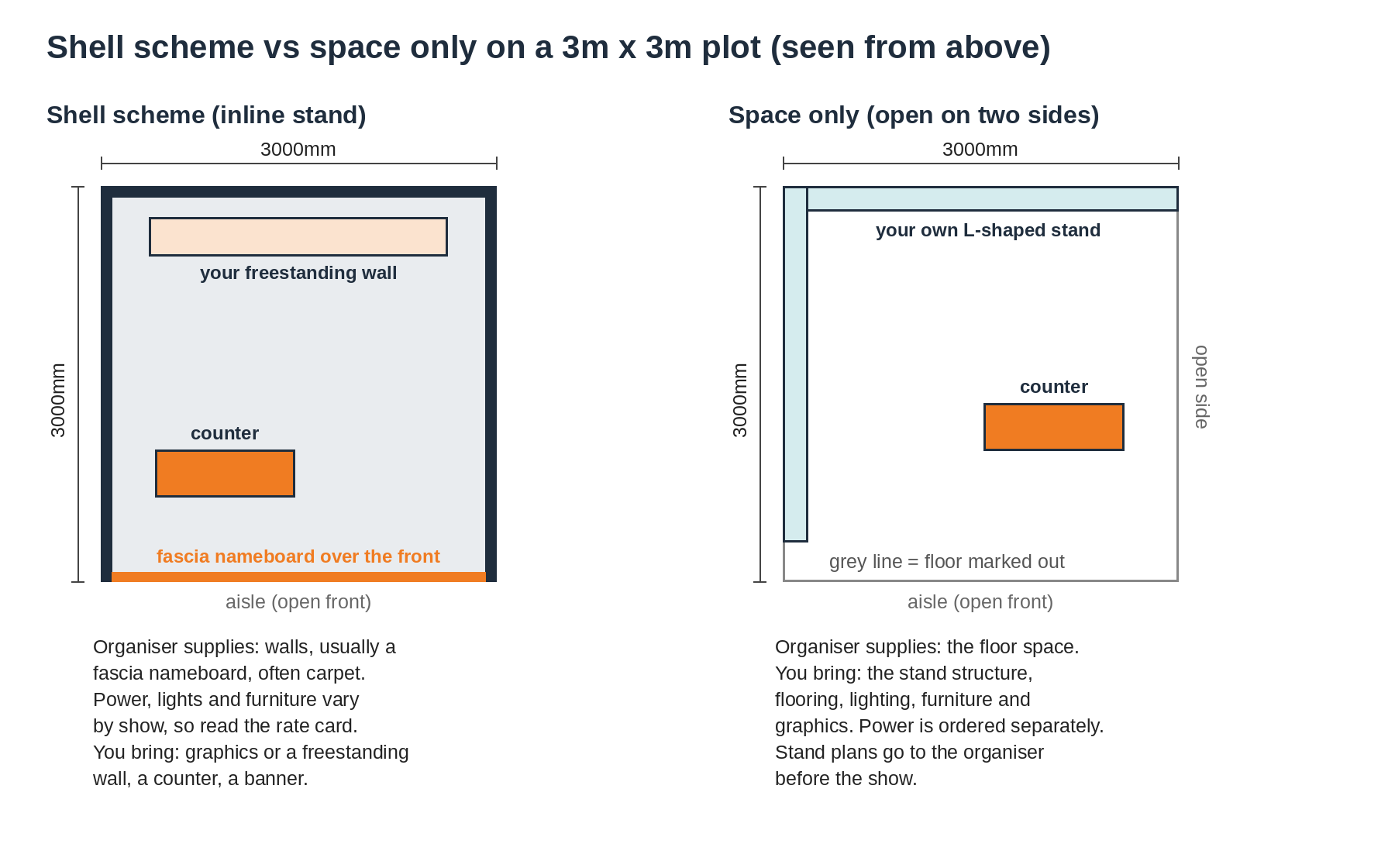
A shell scheme is the basic structure an exhibition organiser puts up inside your stand space. It is a standard package including walls, usually a nameboard with your company name over the front, and whatever else the rate card lists. You walk in on build-up day and dress the shell scheme walls with your own graphics, a counter and a banner or two.
What the package includes varies a lot from show to show, so read the rate card before you sign. Lighting and power are the ones that catch people out. Of the 26 shell rate cards in our research that list their inclusions, only 7 included power, 4 said electrics cost extra and 15 did not mention it at all. If you plan to run a lightbox or a screen, check the show manual for a socket and order one if it is not included. It is also worth asking whether your neighbour’s stand shares a wall with yours.
The other thing to check is the space inside the walls. Wall uprights take up some of the nominal size, so a 3m wide shell is a little less than 3m inside, and anything freestanding has to fit under the fascia. Get the internal width, depth and clear height from the exhibitor manual before you order a display for a shell scheme booth, and size any shell scheme graphics to the panel dimensions it gives.
What a space-only exhibition stand means for the exhibitor
Space only means paying for the floor and nothing else. The show marks out your area in the exhibition hall and you supply everything on it: the stand structure, flooring, lighting, furniture and graphics, with power ordered separately. It is a blank canvas with complete creative control, so your brand can use the whole exhibition space, with open sides, meeting areas and product displays wherever you want them.
That freedom brings paperwork. Under the AEV eGuide, which most UK venues follow, detailed scale drawings of every space-only design have to go to the organiser, together with details of the materials, a risk assessment and method statements. In our exhibitor deadlines research, those stand plans were due a median of 44 days before the show opened.
There are two ways to fill the plot. A large custom stand, the fully bespoke structure with meeting rooms, AV and raised flooring, comes from a stand builder or exhibition stand contractor who handles the design and build and the stand build on site, on top of the cost of the space. A smaller plot can take a modular exhibition stand or portable display you own and put up yourself. That second route is the part Stand Central supplies.
Which is more cost-effective, shell scheme or space-only
Most people assume space only is the budget choice, but our research found that is often wrong for a small stand. We paired the shell scheme and space-only rates published on the same rate card at 25 shows, and the walls added a median of £50 per square metre, with no link to how dear the space was. At four of the six dearest shows, the shell added under 5% to the price.
Minimum sizes make the bigger difference. Six of the 26 headline space-only rates set a minimum area, and at all five of those that also publish a shell rate, the smallest space-only option cost 1.3 to 2.1 times a 3m x 3m shell, before a single wall went up.
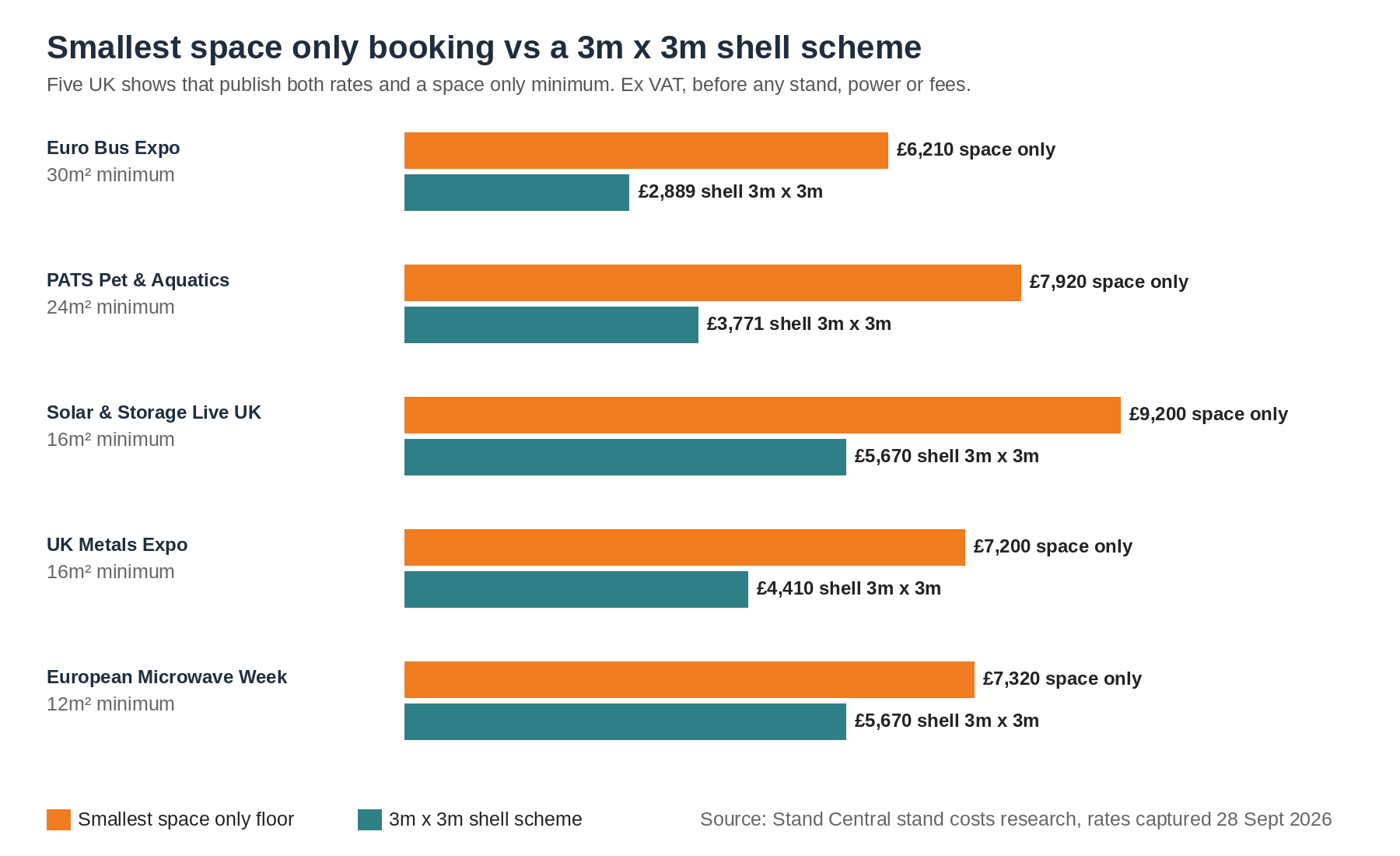
Headline space-only rates ran from £125 to £1,100 per m², ex VAT, across the 26 rate cards we checked, so the show matters far more than the format. Price the smallest space you are allowed in each format, then add power and any compulsory fees before you compare, and ask for the full rate card in writing. On a smaller budget, that sum usually points to a shell.
Best stands to buy when you choose shell scheme
If you use a shell scheme you already have walls, so what you need is something that covers the bare panels with an eye-catching graphic, plus somewhere to stand and talk. Freestanding displays are the easiest route, because many shows restrict nails, screws and tape on the panels. These are the three I would look at for a 3m x 3m shell:
The 3x3 Hop-up fabric pop up stand and counter kit gives you a 2260mm wide, 2260mm tall fabric wall with one continuous printed face, plus a matching 1060mm wide counter with a shelf inside. Each packs into its own wheeled bag, 15.4kg in total, and the kit costs £820.95 ex VAT. It is the simplest complete set for a shell, because at 2260mm wide it fits the back wall of most 3m wide shells with room to spare.

If you want the whole back wall covered, the Quick+ pop up stand 3x3 is 2700mm wide and 2225mm tall on a magnetic scissor frame, at 8.1kg in a padded bag, for £510.95 ex VAT. At 2.7m it is close to the inside width of a 3m shell, so check that measurement first. The 3m x 3m exhibition stand kit is the fuller option at £1,099.95 ex VAT: a 2.4m fabric wall (2350mm wide, 2320mm tall), a monolith display, a square counter and a literature stand, all on tool-free aluminium frames.
- Choose the Hop-up kit if you want a wall and a counter in one order and the walk from the car is long.
- Choose the Quick+ if you want the widest graphic and the inside of the shell is wide enough.
- Choose the starter kit if you want a second display and brochure stand to fill the space.
Our guide to shell scheme stand design goes through how to transform your shell scheme with graphics, lighting and layout once you have booked one.
Best stands to buy when you choose space-only
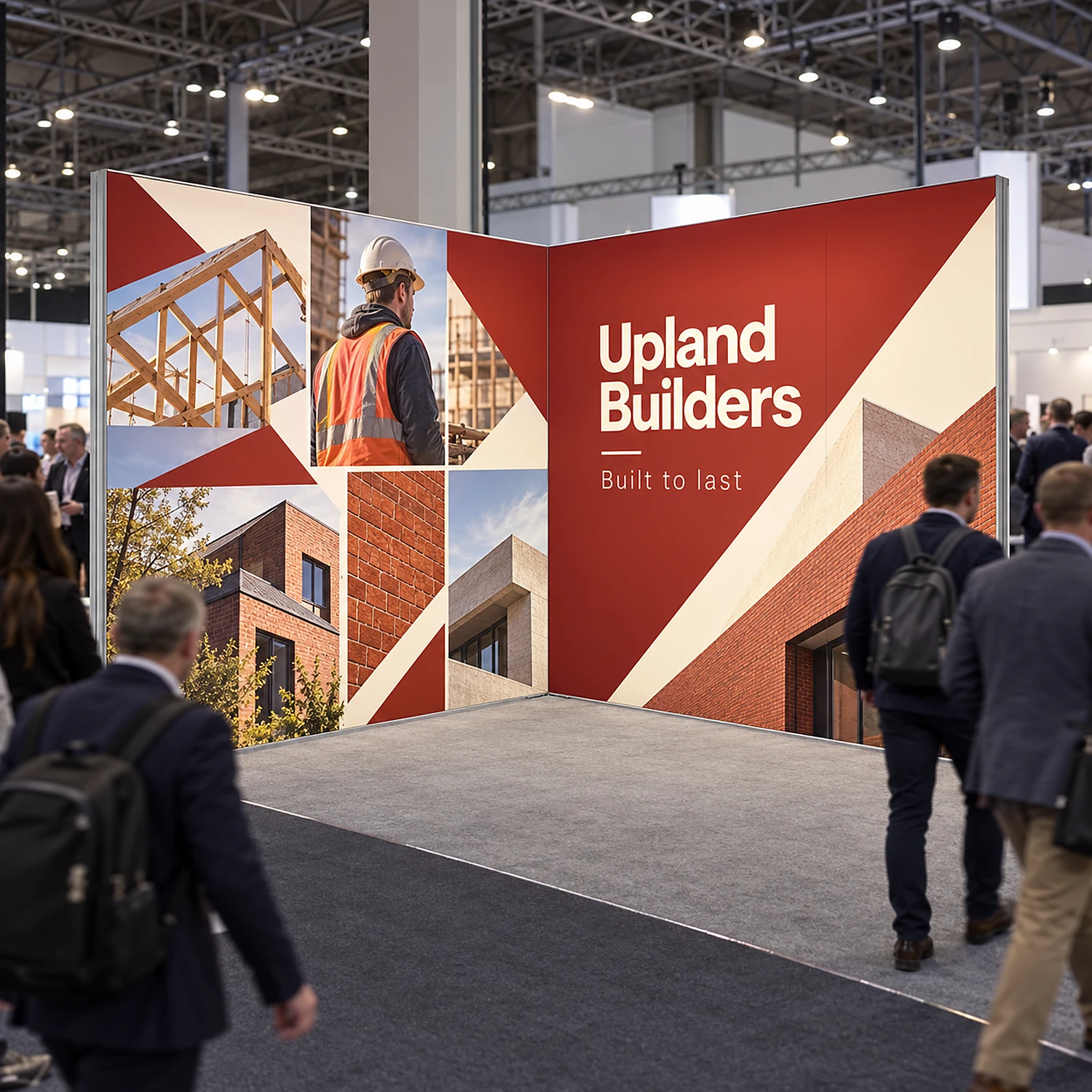
On an empty floor you need a stand that stands up on its own and looks finished from every open side. For a corner plot open on two sides, the frame has to wrap round the back and one side, and anything lit needs the power you order from the show.
For a 3m x 3m corner, the Exhibition Stand Kit 3 LED lightbox stand joins four freestanding LED lightboxes into an L-shaped back and side wall, 2250mm high and 5,700mm long in total. The lights come fitted, the graphics are backlit fabric, it builds without tools and runs from UK 3-pin plug transformers. It costs £3,149.95 ex VAT.
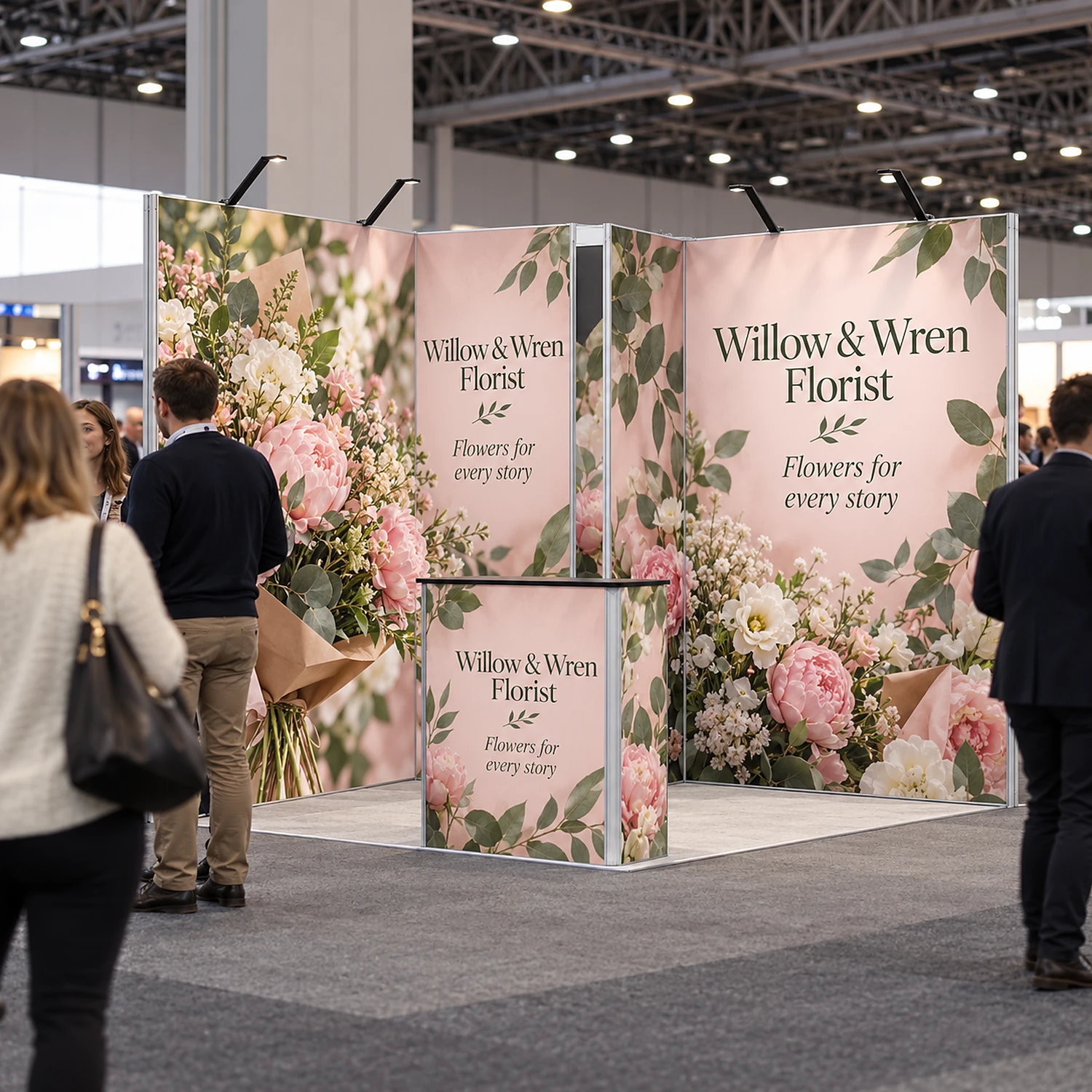
If you need storage, the 9m² Fastframe modular stand with storeroom uses eight 2.4m tall frames to form the walls, with a storeroom door kit that closes off a small room for stock, coats and bags. It comes with two pairs of LED arm lights and a printed counter, the frames arrive already put together, and it costs £3,747.95 ex VAT. The packed weight is 106kg, so plan on a van rather than a car.
For a larger 3m x 6m inline plot, the 3m x 6m exhibition stand kit pairs a 6m and a 3m fabric wall, both 2320mm tall, with a counter, a monolith and a literature stand for £2,124.95 ex VAT.
Shell scheme vs bare space or a freestanding stand
Bare space is just another name for space only, and you will see both on rate cards. A freestanding stand is not a third type of stand space: it is a display that stands up on its own, so it works in either format. You can put a freestanding wall inside the panels of a shell, or use the same frames on bare floor at the next show.
That is the main reason to buy reusable modular or portable frames rather than a one-off build. The graphics can be reprinted for a new campaign, and the same kit can go from a shell one month to a space-only plot the next, as long as you check the sizes each time.
Shell scheme or space-only, and how to choose your stand format
- New to exhibiting, or a small stand such as 3m x 3m: book a shell scheme and add a fabric wall or pop up stand with a counter.
- Dear show with a small stand: a shell is likely to be the better value, because the walls add little and space-only minimums can cost more.
- Corner or peninsula plot where open sides matter: space only, with an L-shaped stand that looks finished from each side.
- You need storage, screens or lighting you control: space only with a stand that has its own storeroom, and order power early.
- You already own a display: either works, so price both and check your stand fits inside the shell and under the fascia.
Whichever you pick, every order includes FREE artwork design or proofing. Our design team can set up your artwork for each frame, or check your own files against our artwork guidelines before print. UK delivery is free on orders of £200 or more. To see every kit, wall and frame system in one place, browse our exhibition stands.
Frequently asked questions
What is the difference between a shell scheme and space only?
A shell scheme is a ready-built stand with walls and usually a nameboard, put up by the event organiser. Space only is bare floor marked out for you, and you bring the whole stand, lighting, flooring and furniture, and send plans to the show before it opens.
Is shell scheme cheaper than space only?
Often, for a small stand. In our research the shell added a median of £50 per m² over space only on the same rate card, and at all five shows with a published space-only minimum, the smallest space-only floor cost 1.3 to 2.1 times a 3m x 3m shell.
Can I use a pop up stand inside a shell scheme?
Yes, if it fits. Measure the internal width and the clear height first. A 2260mm wide Hop-up stand sits inside a 3m shell with room to spare, while a 2700mm wide Quick+ stand needs almost the full inside width.
Do I need a stand builder for space only?
Not always. A small space-only plot can take a modular or portable stand you own and build yourself. Larger custom stands are normally designed and built by a stand builder, who also prepares the plans the show needs.
What does bare space mean at an exhibition?
Bare space is another name for space only: you get the marked-out floor and nothing else. You supply the stand structure, flooring, lighting and graphics, and order power separately from the show.