FREE UK delivery on orders of £200 or more
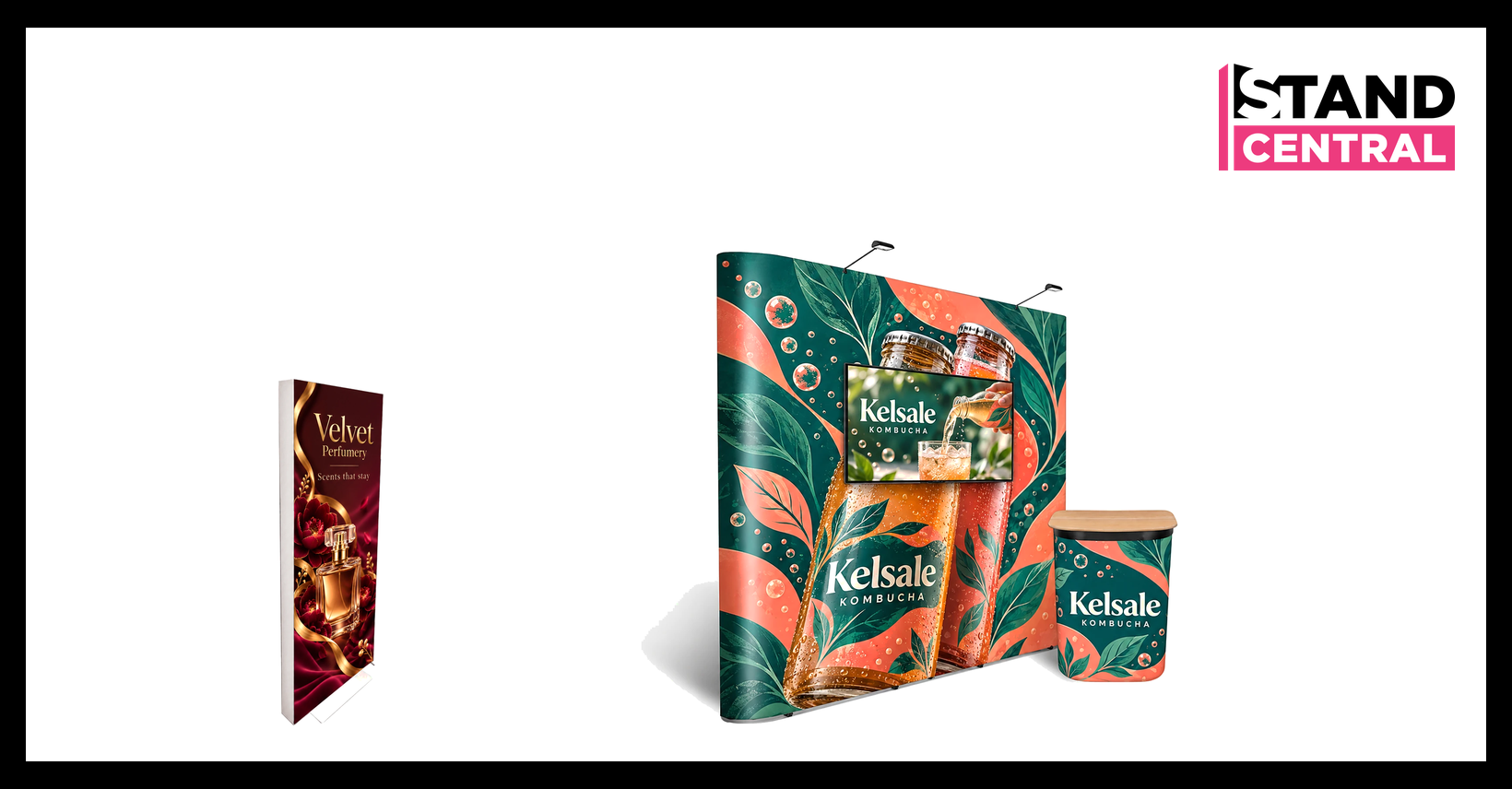
When you compare an LED lightbox vs digital signage, the short answer is that a light box is the better buy for one strong message that has to be seen from a distance all day, and a digital screen is the better buy when you need video, a demo or content that changes. A light box tends to cost less to buy, needs nothing more than a plug, and the LED lights behind the printed graphic make it glow evenly, so people can see your sign from far away across a hall. A screen costs more once you add the display, the holder and the content, but it is the only one of the two that can move.
We sell LED light boxes and the stands and brackets that hold a screen, but not the screens themselves, so every price below is for the unit or the holder from our own range. Prices are ex VAT and were checked on our product pages on 13 November 2026.
Key takeaways
If you only read one part of this guide, these are the points that decide it for most stands, shops and receptions.
- Choose an LED light box for your brand, an offer or a product photo that stays the same for the whole event. Our portable light boxes start at £276.95 ex VAT with the printed graphic included.
- Choose digital signage when you need moving content, such as a product video, a demo loop or offers that rotate through the day. Screens cost more at first, and the screen itself is extra.
- A screen needs more than the stand. You also need the screen, something to play the content and someone to keep the content up to date.
- You can have both. A lit wall carries the brand from the aisle and a screen on a bracket explains the product once people stop.

LED lightbox vs digital signage at a glance
The quick difference is that a light box lights a printed graphic from behind, and digital signage shows content on a screen that you can change. The table compares them on the points that usually decide it.
| LED light box | Digital signage | |
|---|---|---|
| What it shows | One printed graphic | Video, slides, changing content |
| Seen from | Across a hall or shop | Close up, at the stand |
| Needs | A mains socket | Screen, player, content, socket |
| Changing the message | New printed graphic | New file |
| Our range from | £276.95 ex VAT | Stand from £674.95, screen extra |
| Best for | Brand and one clear offer | Demos and rotating content |
The big difference is what you are paying for. With a light box the price covers the frame, the LED lights and your printed graphic, so it is ready to use out of the case. With a screen, the stand or bracket is only part of the cost, and the screen and the content still have to come from somewhere.
What an LED light box sign does well
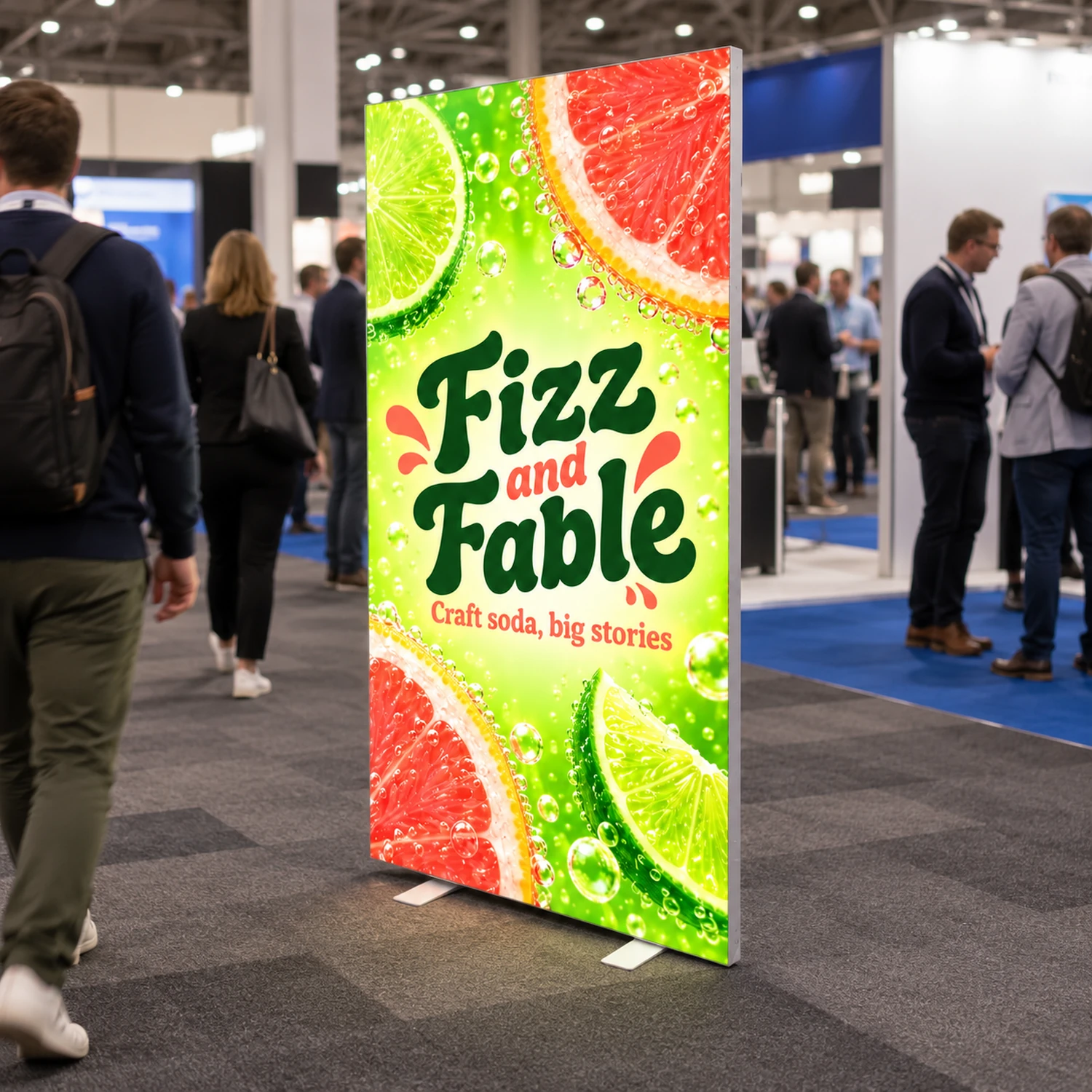
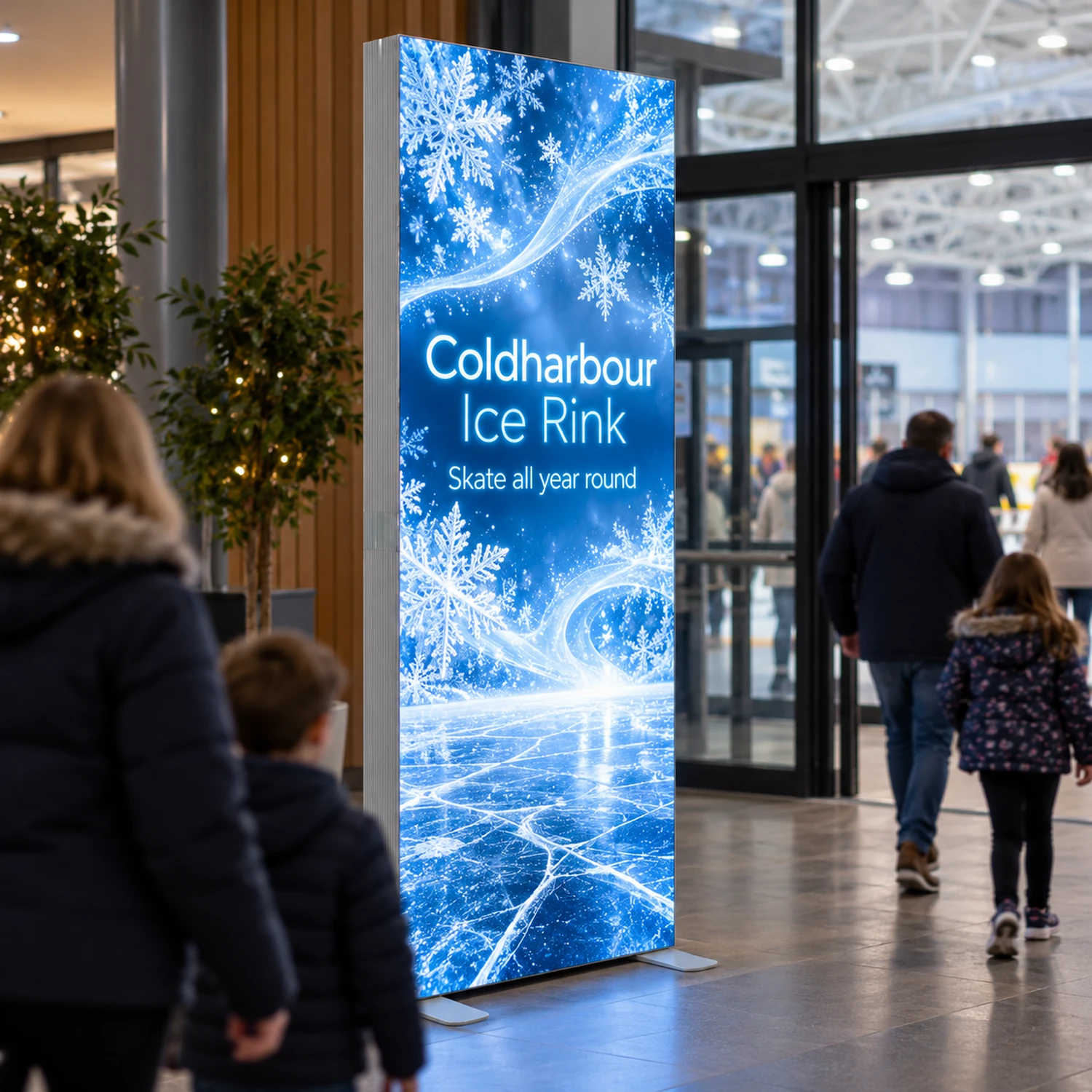
An LED sign like this is at its best when you want one message to be seen clearly from a distance, for the whole day, without anyone looking after it. The LED lights sit inside the frame and shine through a printed fabric graphic, so the image glows evenly rather than reflecting the hall lighting back at people. Lit graphics like this help your message stand out and make your sign easy to read, and they are a good way to show off your brand, an offer or a product photo.
Bright light and even light are the main reasons people pick one, and they are what LED light boxes give you over a printed banner. On the Illumigo Lite Mag, four vertical strips of LEDs give a cool white light across the graphic, rated at 1551 lumens. Other units in the range spread light evenly from LEDs around the inside edge of the frame, so the light sits evenly across the whole graphic. Either way, a lit graphic stands out in a dim exhibition hall or a busy shopping centre, where an unlit banner can look flat next to its neighbours.
LED light boxes work well for busy people because they are simple to run. You build the frame, press the graphic into the channel round the edge and plug it in. There is no media player to set up, no files to load and nothing to freeze or need a restart halfway through the day. When the event ends it packs into its case, and the next time you use it the message is already there.
Changing the message means changing the print, which is the main trade-off. The graphics are dye-sublimation printed fabric with a silicone edge, so a new one pushes into the same frame and you do not need new hardware. That suits seasonal offers, a new product launch or a rebrand, but not something you want to change every hour. For shop use, my guide to the best lightbox for retail display covers the options in more detail.
Our light boxes are made for indoor use, so for anything outdoors you would need a product sold as outdoor LED signage, which is built to deal with the weather.
LED vs traditional light boxes
Compared to traditional light boxes lit by fluorescent tubes, an LED version is slimmer, lighter and generally uses less energy, which is why almost every portable light box sold now uses LED technology. If you are replacing an old box sign, that is the main thing that has changed.
Older light boxes used tubes behind an acrylic or poster panel, so they were deep, heavy and needed bulbs changing. With LED light boxes the LEDs come fitted in the frame and generally last a long time, so you do not need to change bulbs the way you did with tubes. The frame profile can also be slim, 100mm on the Illumigo Retail and 120mm on the Glopix range, so it packs into a case or bag you can carry. For a shop or a stand, switching to LED light boxes is mostly about saving money and time on carrying, set up and power.
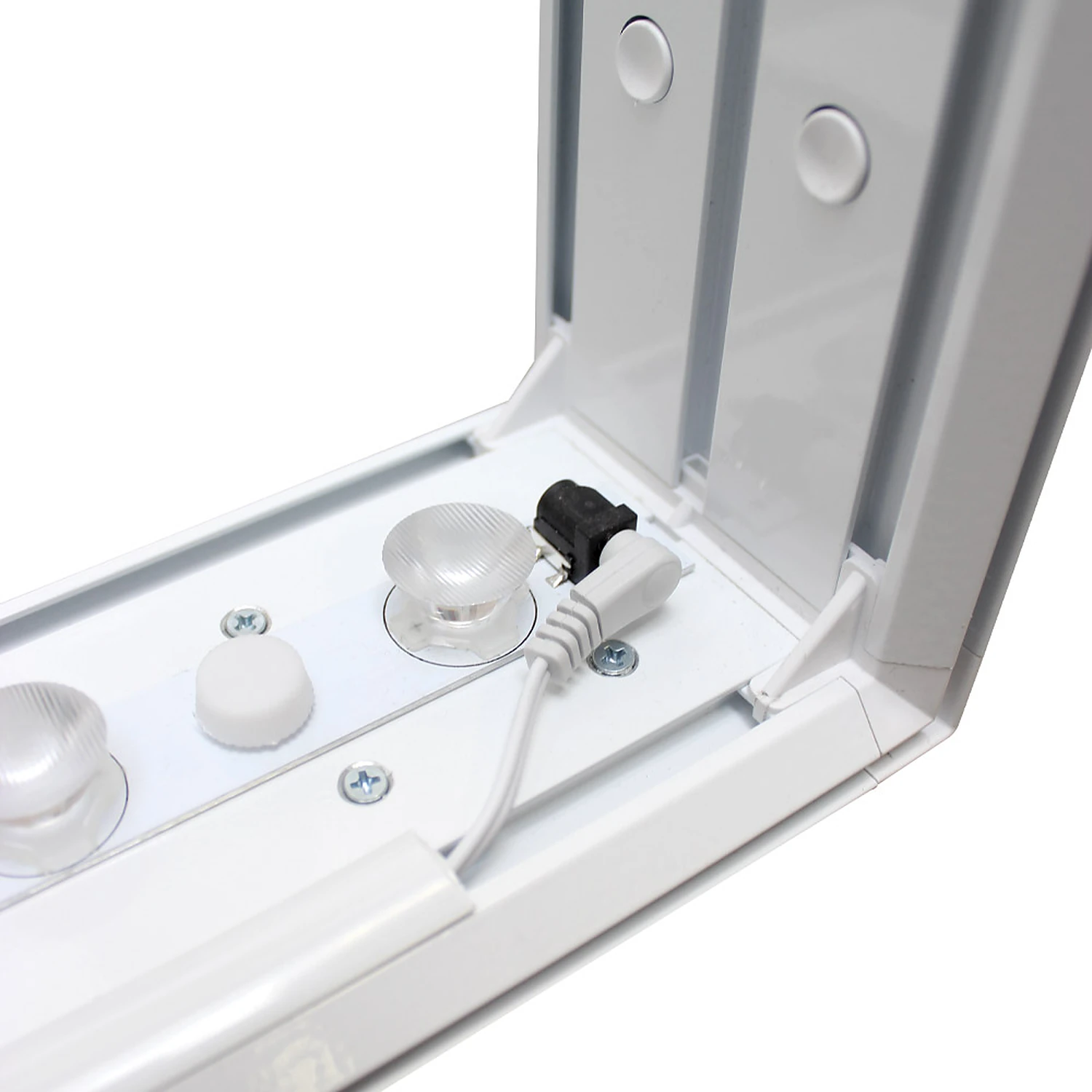
Our range lights the graphic in one of three ways. The Illumigo Retail has LED pods like these, the Illumigo Lite Mag has four vertical LED strips and the Illumigo One has a roll-up LED panel. Each is built so the light spreads across the whole print, and these light boxes help keep the frame slim and the set up quick.
What digital signage does better
Digital signage is better whenever the content needs to move or change. A screen can play a product video, run a demo, show a slideshow of case studies or rotate offers through the day, and you can change any of it by swapping a file rather than reprinting.
That makes a screen the stronger choice for products that are hard to explain in a single image, such as software, machinery or a service with several steps. It is also useful for anything time-based, like a schedule of talks, a countdown to a prize draw or a lunchtime offer in a shop.
The catch is that a screen is a small, detailed display. It works best for people who are already standing at your stand or in front of your counter, and a video with small text or fast cuts can be hard to follow from the aisle. On a busy stand it is often the second thing people look at, after something bigger has caught their eye.
Digital signage also needs more looking after. Someone has to make the content, load it onto the screen or a player, check it is running at the start of each day and make sure the sound is right if there is any. Glare from overhead lights can make some screens hard to read at certain angles, so it is worth thinking about where it will face before the event.
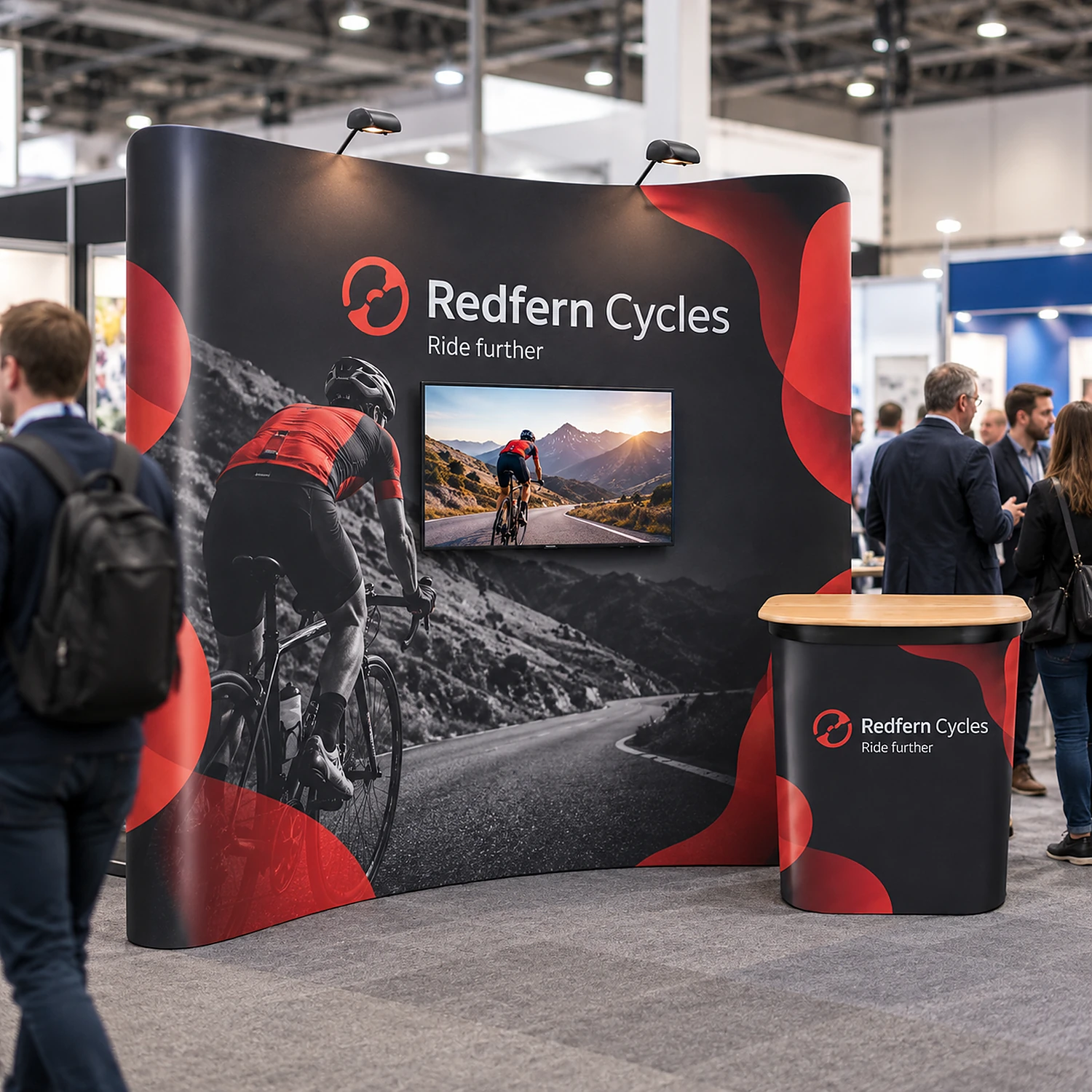
If you have already decided on a screen, our Vision curved pop up TV stand 3x5 holds a 20 to 50 inch TV in the printed wall and comes with two LED lights, and the wheeled case turns into a counter. My guide to the best exhibition stand for a TV screen goes through every way we have of holding one.
Cost comparison of LED light box signs and digital screens
On price alone, the lit graphic costs less, because the price includes everything you need to use it and a screen holder price does not include the screen. Our portable light boxes start at £276.95 ex VAT, while our freestanding Standroid monitor stand is £674.95 ex VAT before you buy the screen.
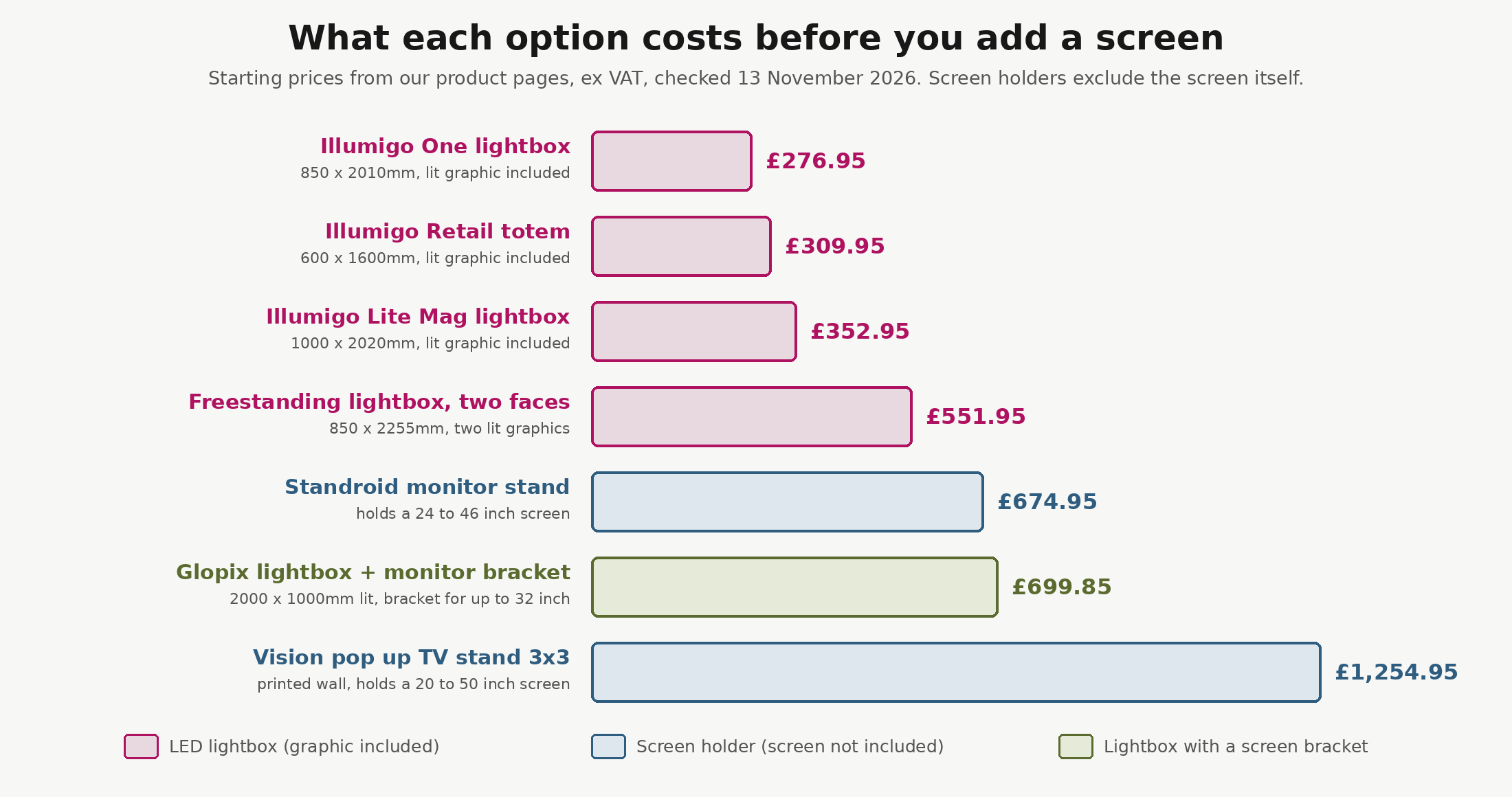
These are the starting prices from our range, all ex VAT and checked on 13 November 2026.
- Illumigo One portable lightbox, 850 x 2010mm, single sided, from £276.95.
- Illumigo Retail totem, 600 x 1600mm, made for shop floors and windows, from £309.95.
- Illumigo Lite Mag, 1000 x 2020mm, joins to other frames with magnets, from £352.95.
- freestanding double-sided LED display, 850 x 2255mm, two lit graphics, from £551.95.
- Standroid monitor stand, holds a 24 to 46 inch screen up to 22.7kg, from £674.95 without the screen.
- Vision straight pop up TV stand 3x3, a printed wall that holds a 20 to 50 inch screen, from £1,254.95 without the screen.
The screen is the cost that is easy to forget. The holder is only half the job, and you will also need the screen, a way to play the content (a USB stick, a media player or a laptop, depending on the screen) and the time to make the video or slides. If you already own a suitable TV, a screen holder becomes much better value.
Over several events the picture is similar. A light box keeps costing nothing extra until you want a new graphic, while a screen may need new content for each show. Neither is wrong, but if your budget is tight and one message will do, the light box gives you more for the money.
Power use, LED lights and how to save energy
Both need mains power, and at most shows you book a socket for your stand, so plan for one whichever you choose. Like many LED light boxes, ours run from a standard mains socket and draw less power than most people expect. You can check the figure on the product page before you buy.
As an example, the Illumigo Lite Mag is listed at 72.2W. Left on for 8 hours a day over a three-day show, that is about 1.7kWh in total. A screen’s power use depends on its size and model, so check the label or the manufacturer’s specification for your screen and work it out the same way (watts x hours, divided by 1,000).
So you do not need to choose on energy alone. LED light box signs generally use less energy than older tube-lit boxes and are cheap to run, but the bigger difference between the two is still what they show and how much looking after they need.
Set up, content and day-to-day work
A light box is quicker to get ready, because the only content is the printed graphic and that is sorted before the event. The Illumigo One builds in under ten minutes with no tools, its feet are already fixed to the frame, and the LED panel rolls up for transport with its LEDs in place.
Digital signage takes more planning. As well as putting up the stand or bracket, you need the screen fixed securely, the cables tidied, the content tested on that exact screen and a plan for who checks it each morning. The Standroid, for example, takes about 15 minutes for two people to put up, and the screen goes on after that.
Artwork is the same job for both, just in a different format. For a light box, your design is printed on backlit fabric, and our artwork guidelines explain the file setup, with a free template for each size. Every order includes FREE artwork design or proofing, so you can send your own file for us to check or have our team design it for you. For a screen you need a video or slide file in a format the screen can play.
Moving between events is easier with a lit frame too. The Illumigo One weighs 5.6kg and packs into a padded case, while a screen needs its own protective packing and travels as separate pieces.
Using both, a lit wall with a screen on it
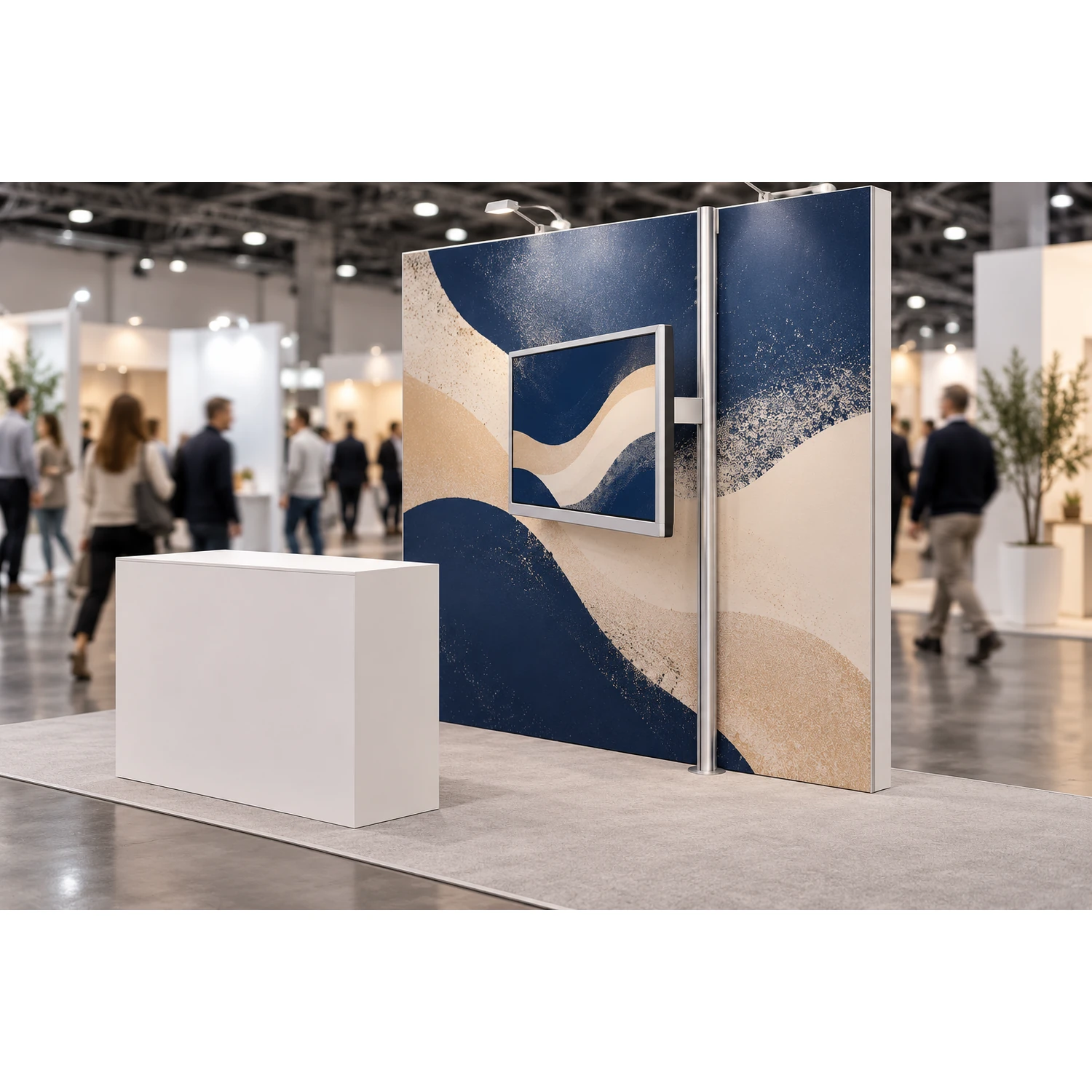
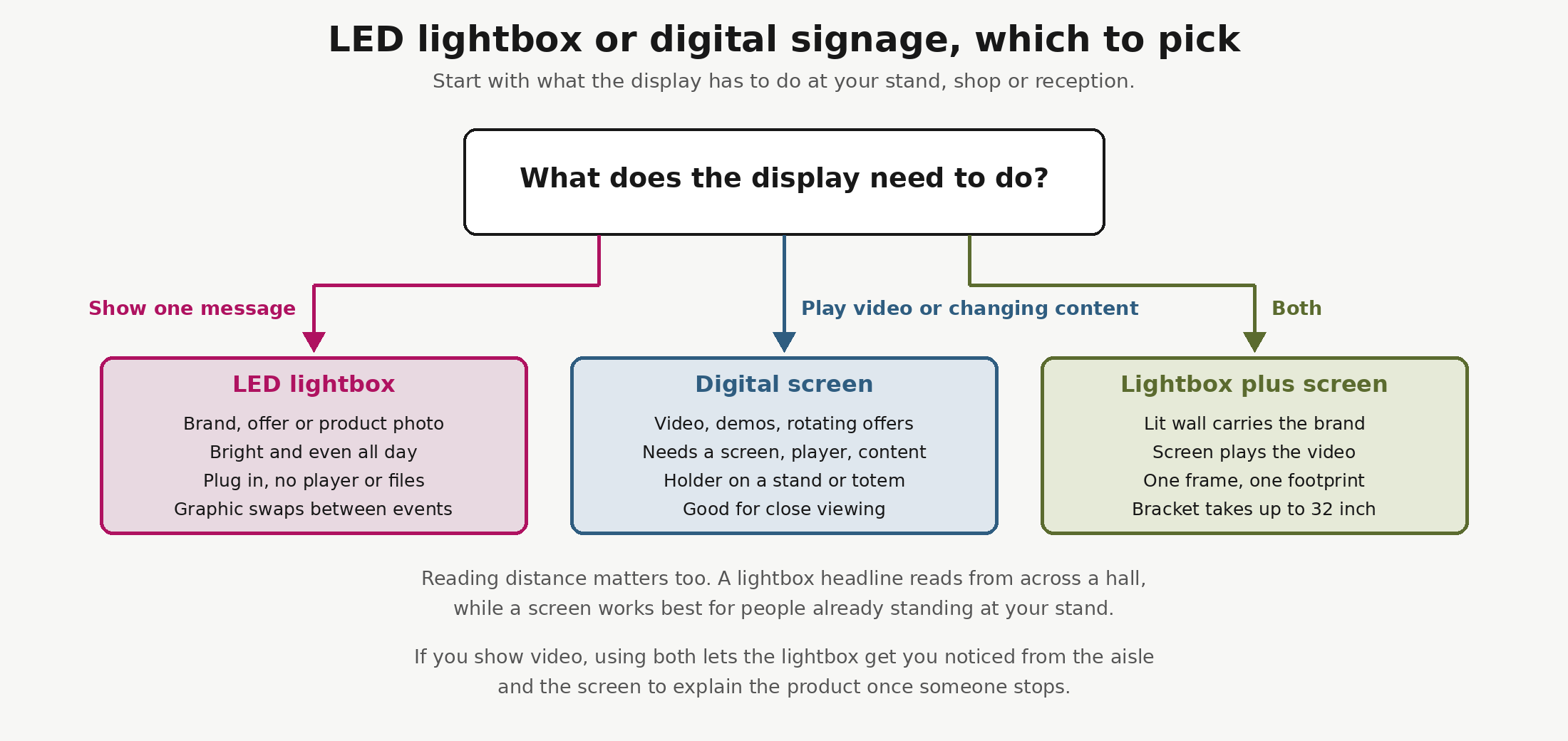
If you want the reach of a light box and the detail of a screen, you can put them together. A lit graphic catches people from the aisle, and a screen on the same display explains the product once they stop, so the two are not really competitors at all.
The neatest way is a light box with a screen bracket. Our Glopix monitor bracket fits the 1000mm wide Glopix light box and holds a monitor up to 32 inches and 6.8kg. It needs a pair of 20 inch side locked feet for stability. With the Glopix 2000 x 1000mm frame (£572.95 ex VAT, double-sided print), the bracket (£57.95) and the feet (£68.95), that comes to £699.85 ex VAT before the screen.
If you already own a pop up stand, a screen mount for straight pop up stands (or the curved version) costs £108.95 ex VAT and holds a screen up to 540mm and 5kg with a VESA 50, 75 or 100 fixing. That suits a small monitor running a looping video rather than a large TV.
For a larger stand, you can also run a row of light boxes as a backwall and stand a screen in front of them on its own feet. Our backlit display walls and LED backlit totems give you a range of sizes for that.
Choosing the right LED sign or screen for a stand, shop or reception
Choose a lit graphic when one message will do, choose a screen when the message has to move, and use both when you need people to notice you and then understand a product. These decision rules should help you pick the right sign.
- Best for an inline exhibition stand with one brand message. A single-sided unit such as the Illumigo One portable lightbox against the back of the stand, seen from the aisle.
- Best for a shop floor, window or till point. The Illumigo Retail totem, which is 600mm wide and made to move between stores.
- Best for a reception or open entrance seen from both sides. The freestanding double-sided LED display, which lights both faces.
- Best for a product demo or video on a 3m stand. The Vision straight pop up TV stand 3x3 if you are buying a stand anyway, or the Standroid monitor stand if you need the screen to stand on its own.
- Best for getting noticed and explaining the product. The Glopix 2000 x 1000mm frame with the Glopix monitor bracket, so one frame carries the lit graphic and a screen up to 32 inches.
If you have gone for a light box, the next choices are how it stands and how many faces it has. My guides to a freestanding vs wall mounted lightbox and a single vs double sided lightbox cover those.
How we compared
This is a desk comparison of published information, not a side-by-side test. I compared the LED lightboxes we sell (Illumigo One, Illumigo Retail, Illumigo Lite Mag, the freestanding double-sided display and Glopix) with the ways we have of holding a screen (Standroid, Vision pop up TV stands, pop up screen mounts and the Glopix monitor bracket) on price, what is included, power, set up and transport. All figures come from our live product pages, checked on 13 November 2026. Screen costs and power use depend on the screen you choose, so they are left out.
Frequently asked questions
These are the questions people most often ask when choosing between a lit graphic and a screen.
What is the main difference between digital signage and a light box?
A light box lights a printed graphic from behind, so it shows one fixed message. Digital signage shows content on a screen, so it can play video and change. The light box is better for being seen from a distance, and the screen is better for detail and moving content close up.
Is an LED light box cheaper than digital signage?
Usually, yes. Our portable LED light boxes start at £276.95 ex VAT with the printed graphic included, while our freestanding Standroid monitor stand is £674.95 ex VAT without the screen. If you already own a pop up stand and a small monitor, a screen mount at £108.95 ex VAT closes most of the gap.
Do LED light boxes use a lot of electricity?
No. Most LED lightbox signs draw very little. The Illumigo Lite Mag, for example, is listed at 72.2W, which works out at about 1.7kWh over a three-day show at 8 hours a day. You will still need a mains socket on your stand.
Can I use an LED light box outdoors?
Not the ones in our range. Our LED light boxes are made for indoor use at exhibitions, receptions and shops. For outside you would need a unit sold specifically for outdoor use.
Can I put a screen on a light box?
Yes, on the right frame. The Glopix monitor bracket fits the 1000mm wide Glopix light box and holds a monitor up to 32 inches and 6.8kg, with a pair of side locked feet for stability.