FREE UK delivery on orders of £200 or more
When you weigh up a single vs double sided lightbox, the answer depends on where it will stand. If the back will face a wall or the edge of your stand, buy single sided, because nobody will see a second graphic. If people can walk around it, on an island stand, an open corner or as a divider, buy double sided, because both faces get seen and the extra cost on the same frame is small.
Every price and size here is for units we sell, so the one-sided and two-sided versions are compared like for like. Prices are ex VAT and were checked on 12 November 2026.
Single vs double sided lightbox at a glance
The short version is that one printed face suits a stand built against a wall, and two printed faces suit a unit you can walk around. The table compares both versions of the WaveLight Infinity XS, which we sell either way.
| One printed face | Two printed faces | |
|---|---|---|
| Example | WaveLight Infinity XS, one face | WaveLight Infinity XS, two faces |
| Price from | £430.95 ex VAT | £464.95 ex VAT |
| Display size | 950 x 1360mm | 950 x 1360mm |
| Lit graphics | One | Two |
| Where it stands | Against a wall or stand edge | Island, open corner or divider |
| Packed weight | 11kg | 11kg |
| Best for | Shell walls and back walls | Stands people walk around |
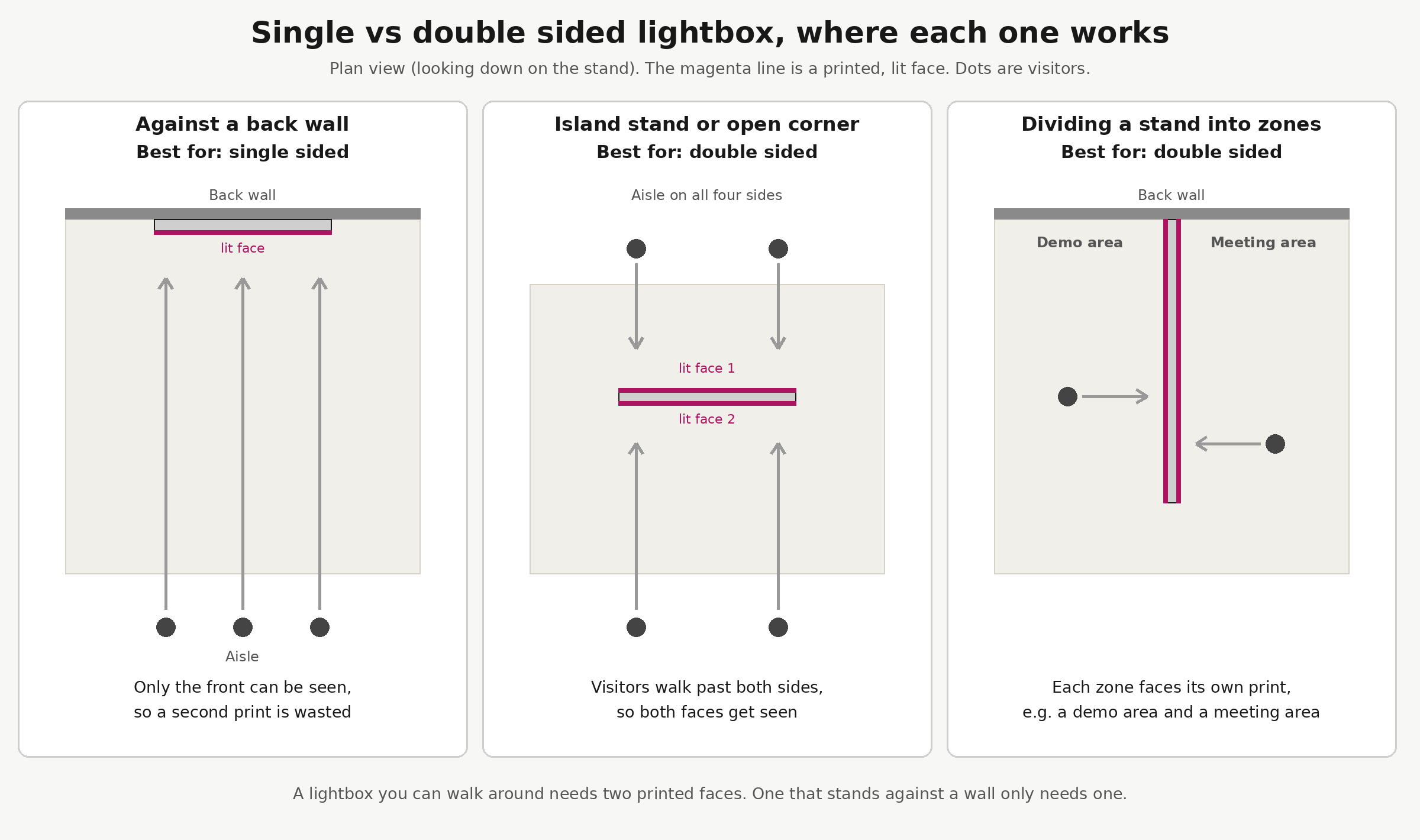
On this unit the second face adds £34.00, and the size, packed weight and carry case stay the same. That pattern holds across most of the range, so the decision is about placement rather than the hardware. The drawing below shows the three usual positions.
What a double-sided LED lightbox gives you
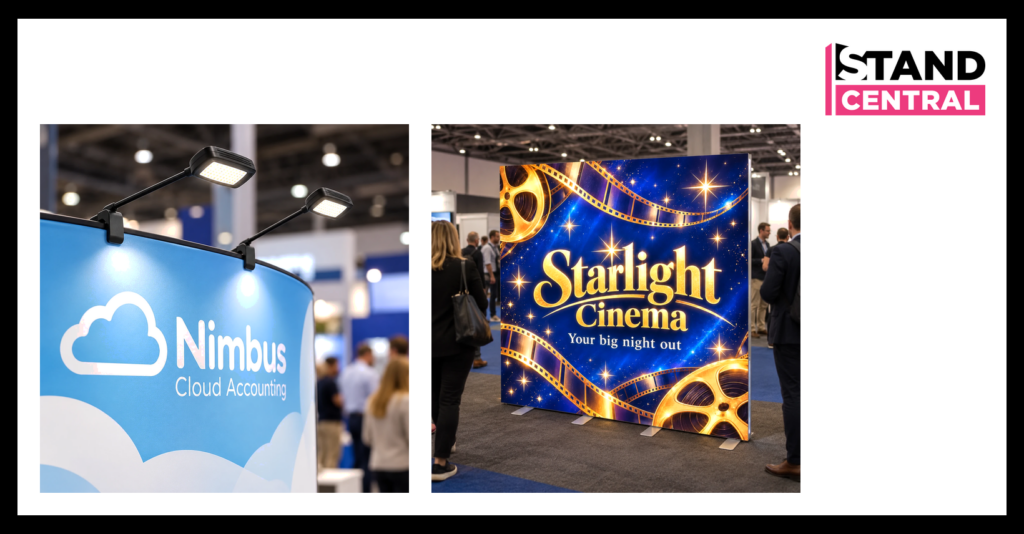
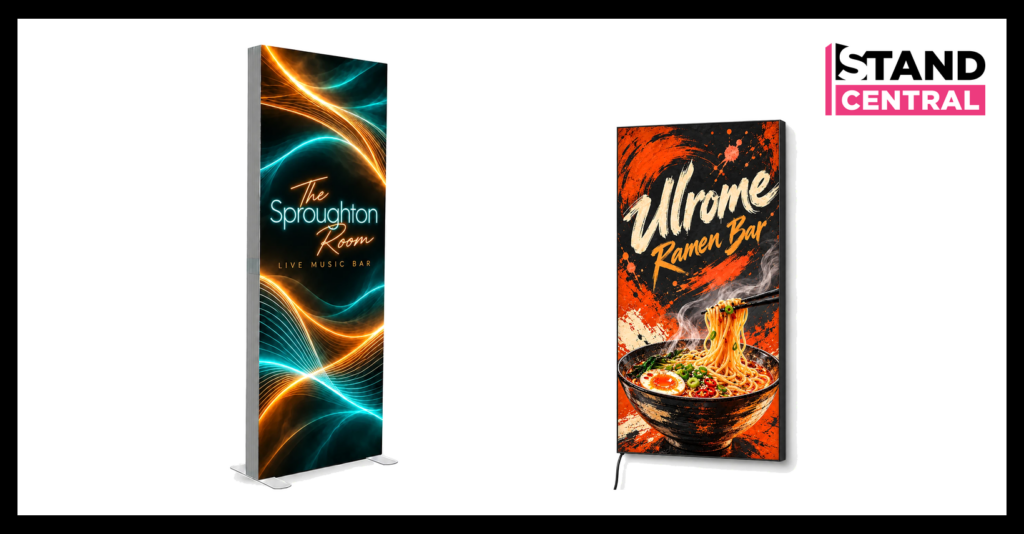
A unit with two lit faces shows an illuminated graphic on both sides, so it works from the front and the back at once. On our two-sided units the LEDs light both prints, and you get two fabric graphics as standard. On the 850mm display, both faces carry your design printed on backlit polyester and illuminated from inside, so vibrant colour holds up in a dim exhibition hall.
That only pays off if people will actually see the back. A unit in the centre of an island stand is seen from every aisle, and one used to split a stand into a demo area and a meeting area faces a different group on each side. Put the same unit against a back wall, though, and the second graphic is printed, lit and never seen.
When a single-sided LED light box makes more sense
A single-sided LED light box is the better buy whenever its back faces a wall, a shell scheme panel or the edge of your space. An inline stand has a back wall and a neighbour on each side, so a unit there is only ever seen from the aisle, and paying for a second print adds nothing.
One-sided units are finished at the back so they still look tidy. The Infinity DNA one-sided version comes with your print plus a blockout back, the WaveLight backlit display wall has a blockout fabric on the back, and on the Formulate LED backwall a one-sided print has a plain white reverse. A blockout layer stops the backlight showing through the back of the unit.
Size matters here too. Large wall-style units such as the Infinity DNA 3m single-sided lightbox at 2953 x 2400mm usually stand at the back of a stand, so the one-sided version at £1,476.95 ex VAT is the sensible choice against £1,707.95 for two faces. You can compare all of our backlit display walls in one place.
Freestanding double-sided lightbox for an island or open corner
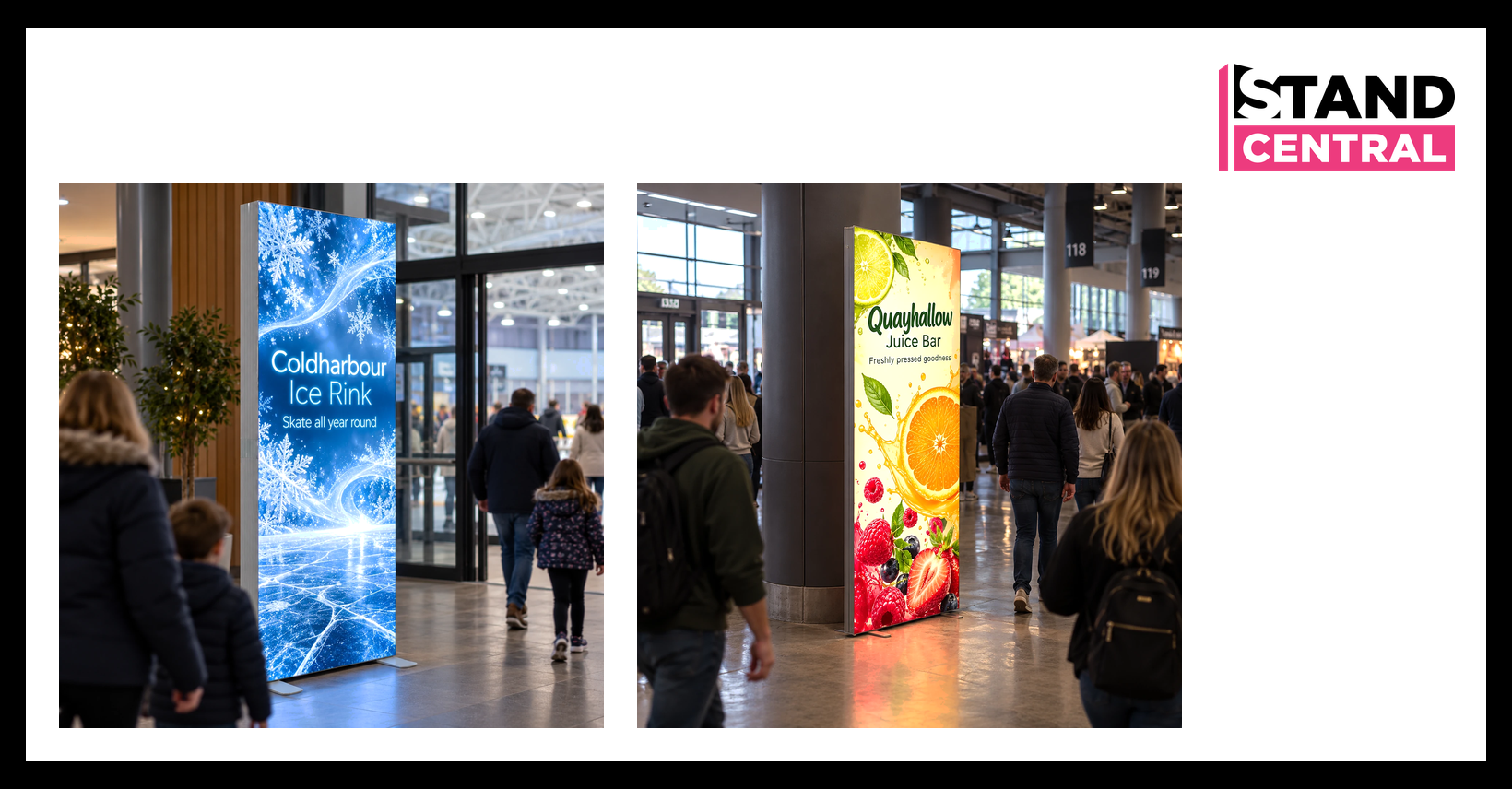
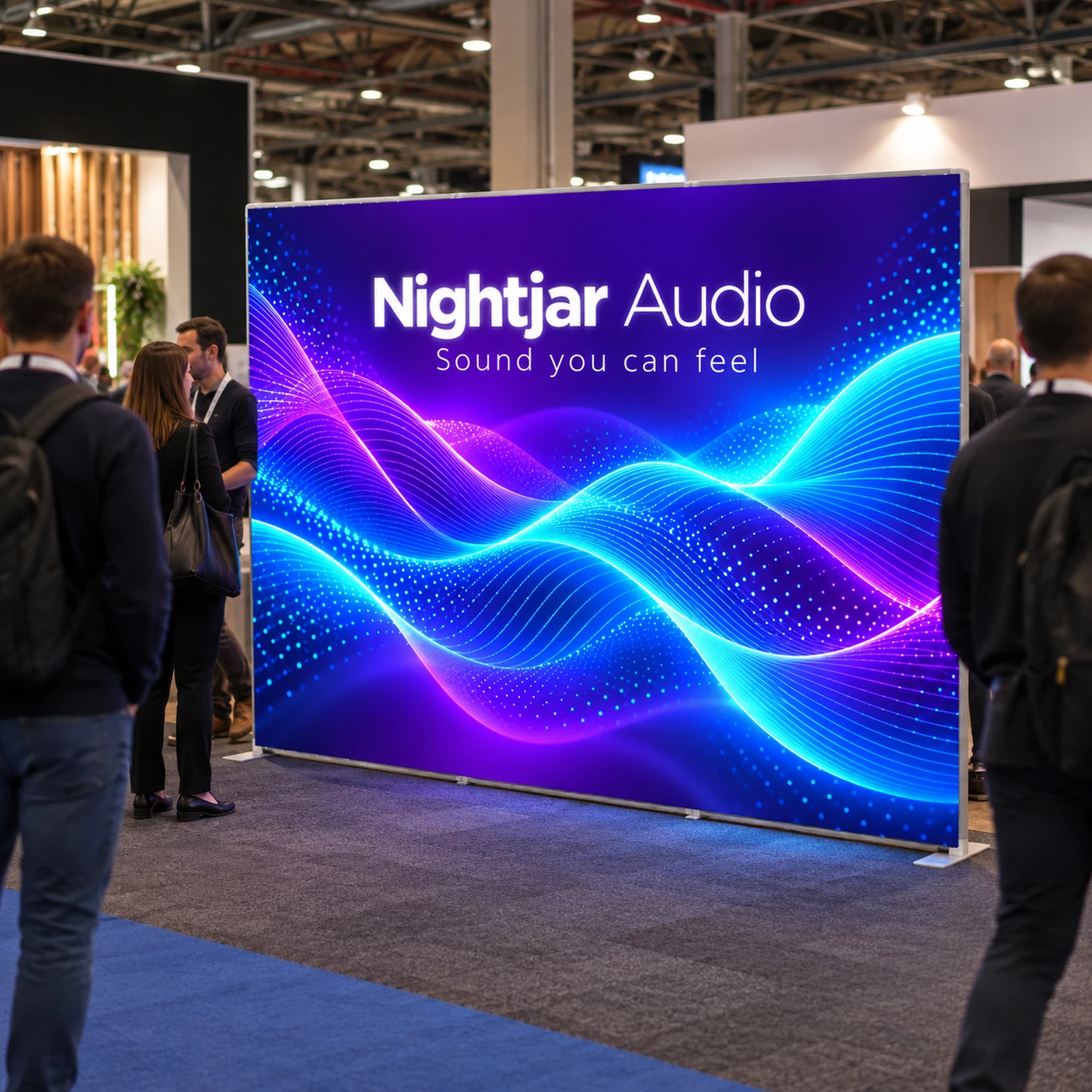
A freestanding double-sided lightbox is the right choice for any spot people can reach from both sides. That covers island stands, open corners on a peninsula stand, the end of a row next to a cross aisle, and receptions, shop window areas or retail displays where a unit stands in open space as signage people can approach from either side.
Our 850mm freestanding double-sided lightbox is a good example. It is 850mm wide and 2255mm tall, needs 400mm of floor front to back, has a 120mm deep profile with the LEDs already built in, runs from a 3m UK power cable, packs to 15.5kg in a wheeled case and is from £551.95 ex VAT, with two printed graphics included. We only sell it with two faces, because a slim unit standing on its own feet is usually seen from both directions.
If you are still deciding whether it should stand on its own or install on a wall, my guide to a freestanding vs wall mounted lightbox covers that choice first. Once the unit is standing in open space, two faces is nearly always the answer, because visibility from both aisles is the whole point.
Price difference between single and double sided light box units
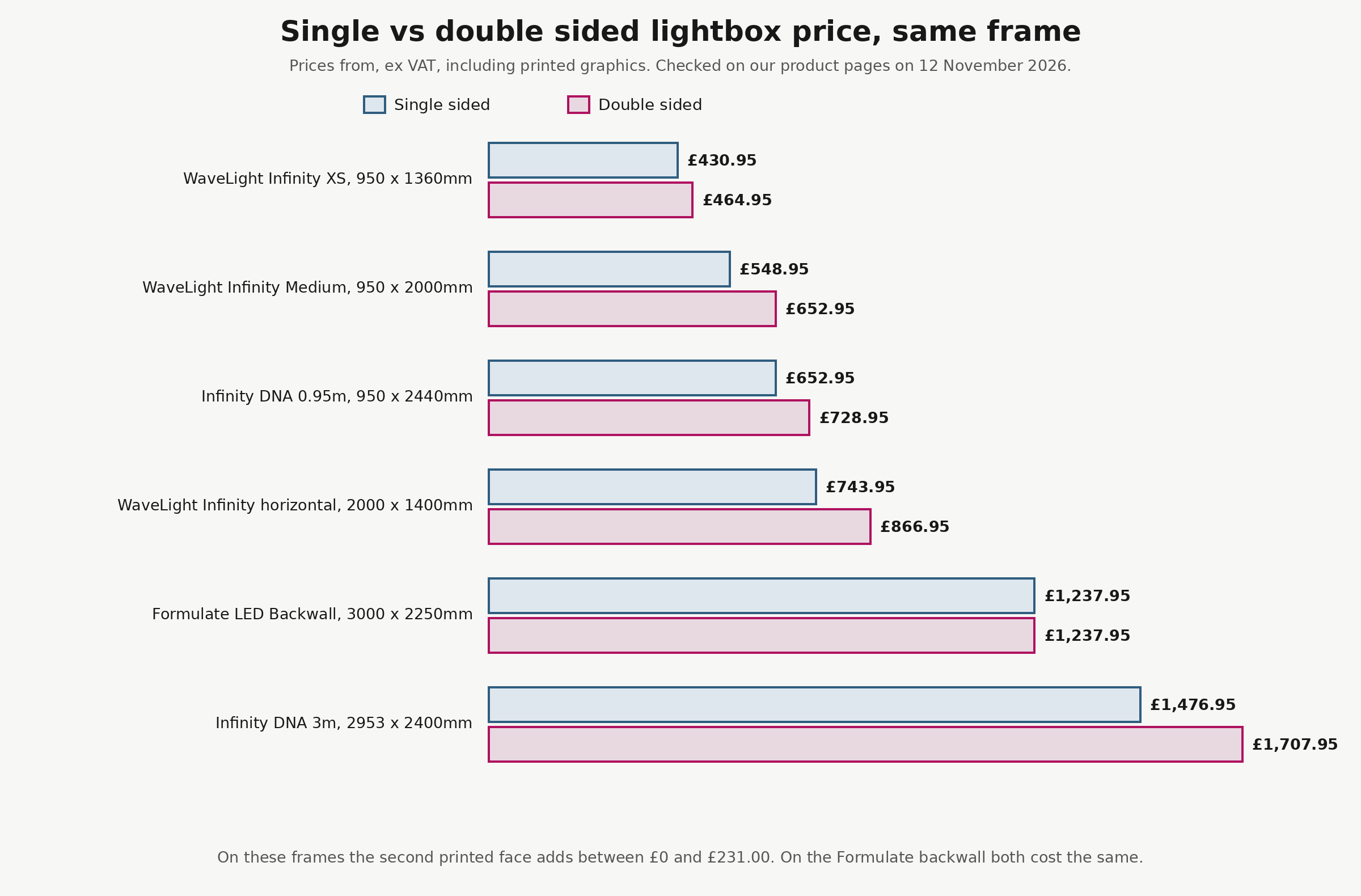
On the units we sell in both versions, the second face costs between nothing and £231.00 more. In percentage terms that is up to about 19% extra for a second printed, lit graphic, not double the price.
- WaveLight Infinity XS, 950 x 1360mm. One face from £430.95, two faces from £464.95 ex VAT, a £34.00 difference.
- WaveLight Infinity Medium, 950 x 2000mm. One face from £548.95, two faces from £652.95 ex VAT, a £104.00 difference.
- Infinity DNA 0.95m, 950 x 2440mm. One face from £652.95, two faces from £728.95 ex VAT, a £76.00 difference.
- WaveLight Infinity horizontal, 2000 x 1400mm. One face from £743.95, two faces from £866.95 ex VAT, a £123.00 difference.
- Formulate LED backwall 3m, 3000 x 2250mm. One face and two faces both from £1,237.95 ex VAT.
So cost should not be the deciding factor. If there is any chance the unit will be used in open space at a future event, the two-sided version is a small premium for a display that works in more layouts. If it will always stand against a wall, keep the money.
Print-ready artwork and colour for each double sided graphic
Each face can carry the same artwork or a completely different design. The same design on both sides keeps your message consistent from every aisle, while two designs let you aim each side at a different audience, for example a product on one face and an offer or a QR code on the other. You can even use a different colour scheme on each face, as long as both match your brand.
The graphics are printed by dye-sublimation on backlit textile with a silicone edge that pushes into the frame, so each face is a separate print you can swap later. The listing for our 850mm unit notes that edge lighting suits busy, colourful designs best, and large areas of one flat colour can show slight differences in brightness, so build some variety into the design if you can.
For print-ready artwork files and accepted file formats, the artwork guidelines ask for a High Quality Print PDF with every colour in CMYK rather than RGB and images at 72 to 125 DPI at full size, and there is a free template for each size with the bleed and safe area marked. Every order includes FREE artwork design or proofing, so you can send your own files for us to check or have our team design both faces for you.
Check which face will glow on a single-sided or double-sided frame
Before you buy, check that the unit lights the second face as well as printing it. On units sold as double-sided lightboxes, such as the WaveLight Infinity, Infinity DNA and the 850mm display, the illumination reaches both illuminated graphics. The Formulate LED backwall works differently.
On the Formulate the light source is three light blankets carrying 360 LEDs, which gives even light distribution across the front. Those blankets face forward, so the front is the lit face and a two-sided graphic gives you a printed back that works as a standard fabric wall. That still suits a backwall whose reverse faces a neighbouring stand or a walkway, and at the same price there is no reason not to print it. Just do not expect the back to glow like the front.
Modular display format and accessories
If you want more than one unit, choose a modular range so the faces can be arranged around your stand. The Infinity frames connect together for larger displays, and the Glopix range has a two-sided print option plus 45, 90 and 180 degree connectors, so several units can form an L, a T or a straight run.
In a connected layout, plan the design layout of each face and work out which ones point at an aisle before ordering. An L in a corner usually needs only its outward faces printed, while a T in open space is seen from three sides. Glopix accessory options such as an A4 brochure holder and a monitor bracket for a screen up to 32 inches attach to the side of the frame, which is worth planning in at the same time.
Which lightbox to buy for your stand
Buy single sided if the unit will stand against a wall, and double sided if people can see or walk around both faces. These decision rules cover most cases.
- Best for: inline stands, shell walls and back walls. Choose a one-sided unit such as the 3m Formulate LED backwall single sided or the one-sided Infinity DNA 3m.
- Best for: island stands, open corners and receptions. Choose a two-sided unit such as the 850mm freestanding double-sided lightbox, which stands on its own feet and is lit on both faces.
- Best for: splitting a stand into zones. Choose a two-sided unit and give each side its own design for the area it faces.
- Best for: a small budget that may change layout between shows. Choose the WaveLight Infinity XS double sided, which costs £34.00 more than the one-sided version and works in either position.
The same thinking applies to banner stands, and my guide to a single vs double sided roller banner covers the cheaper option. If you are comparing frame types rather than faces, see my guide to a pop up lightbox vs SEG lightbox.
How we compared
This is a desk comparison of published information, not a test of the units. I compared the one-sided and two-sided versions of the WaveLight Infinity, Infinity DNA and Formulate LED backwall, plus the freestanding display and the Glopix range, on price, display size, packed weight, what sits on the back and which faces are lit. All figures come from our live product listings and artwork guidelines, checked on 12 November 2026.
Frequently asked questions
Can a double-sided lightbox show different graphics on each side?
Yes. Each face is a separate fabric print, so you can use the same design on both or a different one on each. Two designs work well when the unit divides a stand or faces two different aisles, and you can replace either print later without buying new hardware.
Does a double-sided lightbox cost twice as much?
No. On the units we sell in both versions, the second face costs between nothing and £231.00 more, which is up to about 19% extra. The frame, power supply and case are the same, and the difference is mainly the second printed graphic.
What goes on the back of a single-sided lightbox?
It depends on the unit. Some of our one-sided units come with a blockout fabric on the back, which looks tidy and stops light showing through, and a one-sided Formulate graphic has a plain white reverse. Either way the back is finished, but it carries no printed design.
Is a double-sided lightbox suitable for outdoor use?
Not the ones covered here. They are made to illuminate a print indoors. The Glopix and Formulate units are listed for indoor use, and the rest are fabric units built for exhibitions, receptions and shop floors. Printing a second face does not change that, so check the listing says outdoor before standing any light box outside.