FREE UK delivery on orders of £200 or more

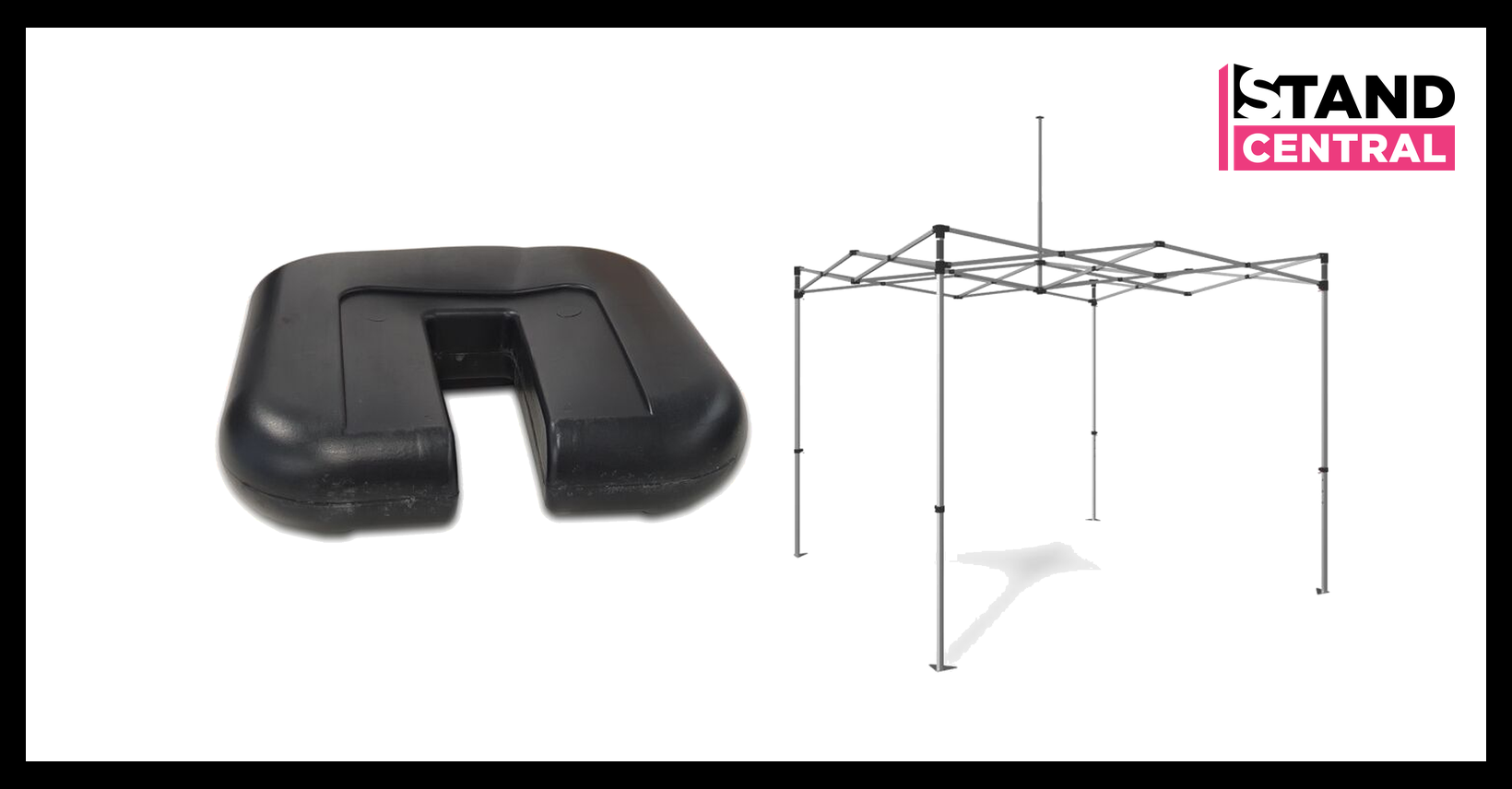
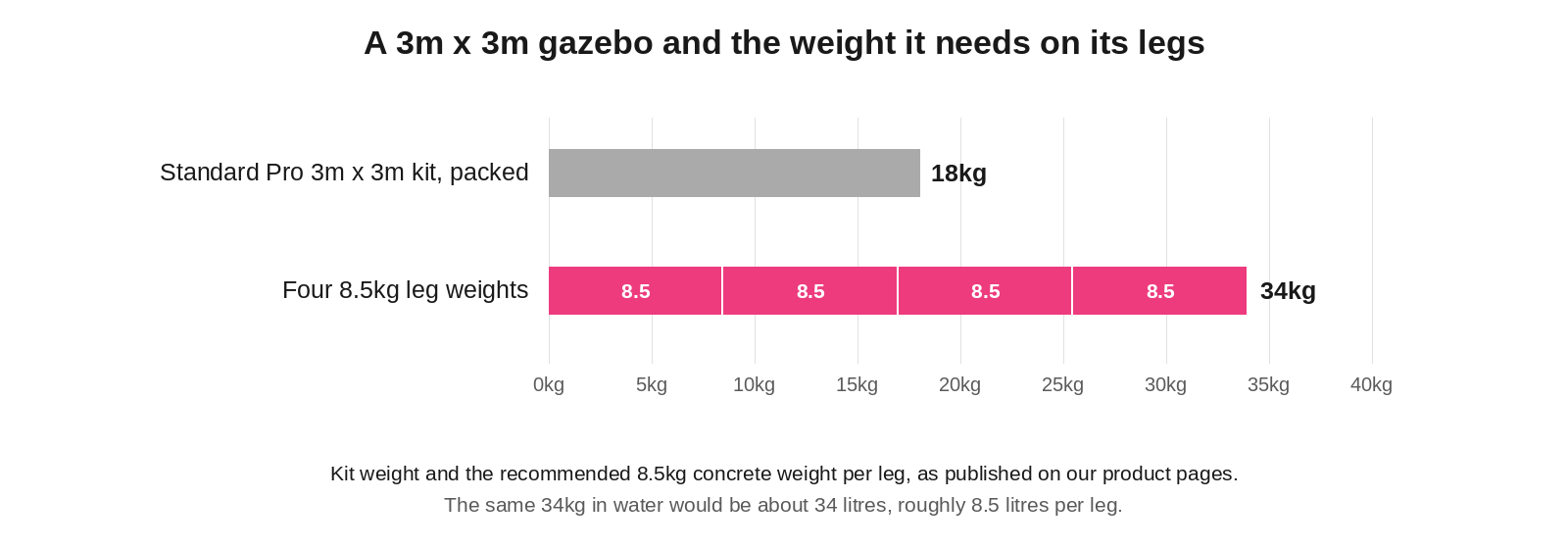
To weigh down a gazebo properly you need a heavy weight on every leg, plus pegs and guy ropes wherever the ground takes them. For our pop up gazebo kits the recommendation is one 8.5kg concrete weight per leg, so a 3m x 3m frame with four legs needs 34kg in total. Weights are what stop a gazebo from blowing away when wind gets under the roof. Pegs help on grass, but on concrete or tarmac you cannot use them at all.
Below I go through how to weigh down a gazebo on any ground: how much weight each leg needs, which method suits which surface and what a wind rating actually means. Prices are our live prices, ex VAT, checked on 21 October 2026.
How much gazebo weight each leg needs
Every kit we sell lists the same recommended leg weight in its specification, an 8.5kg concrete weight on each leg. Our gazebo weights come as a 2-pack, made of heavy-duty concrete with a plastic coating for outdoor use, and the product page recommends a minimum of four. So the sums are simple:
- 3m x 3m frame. Four legs, four weights, two packs, 34kg (about 75lbs).
- Larger frames. The same 8.5kg per leg applies, so count the gazebo legs and order one weight for each.
- In pounds. 8.5kg is about 18.7lbs, useful when another seller lists weights in lbs.
Compare that with the frames themselves. These packed weights are published on our product pages:
| Kit | Packed weight | Wind capacity |
|---|---|---|
| Standard Pro 3m x 3m | 18kg | 13 to 18mph |
| Standard Plus 3m x 4.5m | 22kg | 13 to 18mph |
| Standard Pro 3m x 6m | 34kg | 13 to 18mph |
On a 3m x 3m, four weights add almost twice what the whole kit weighs, and all of it sits at the feet. Without them, a light aluminium frame under a large fabric roof has very little to stop a gust making it lift.
What can I use to weigh down a gazebo?
There are four common methods, and most outdoor events use two together. Pick by the ground you are setting up on:
| Method | Best for | What to check |
|---|---|---|
| Concrete leg weights | Any surface, and the only real option on hard ground | We recommend 8.5kg per leg |
| Pegs and guy ropes | Grass and soft ground | Check the site allows pegging |
| Sandbags or weight bags | Any surface | Weigh each filled bag |
| Water weights | Hard ground, if carrying is hard | About 8.5 litres for each leg |
Gazebo leg weights
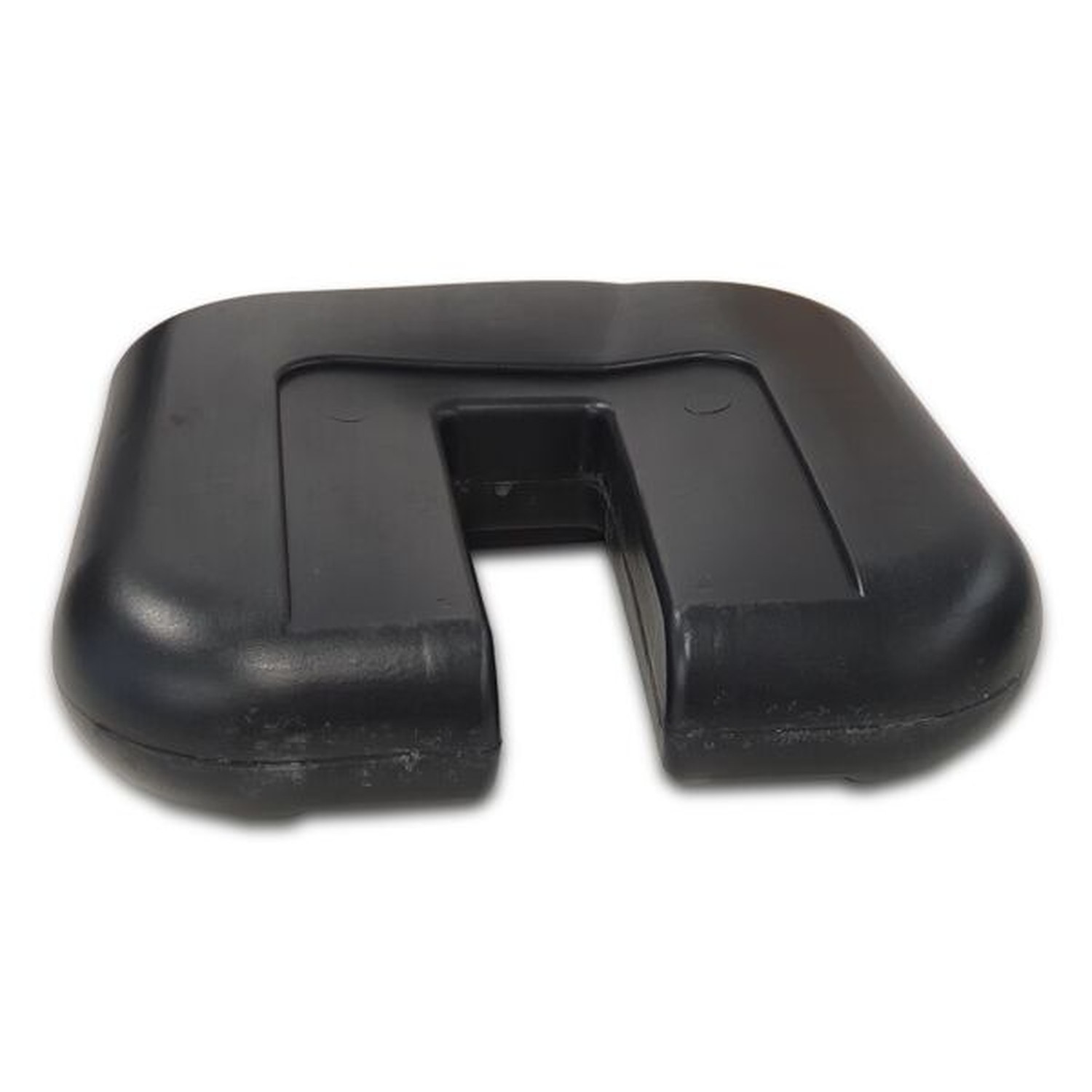
A leg weight is a heavy block shaped to sit around the gazebo foot. Concrete ones are compact for what they weigh and need no filling on site, which is why they are the default for event and market stall setups. They stack for transport, but they are heavy, so plan how they get from the van to your pitch.
Pegs and guy ropes
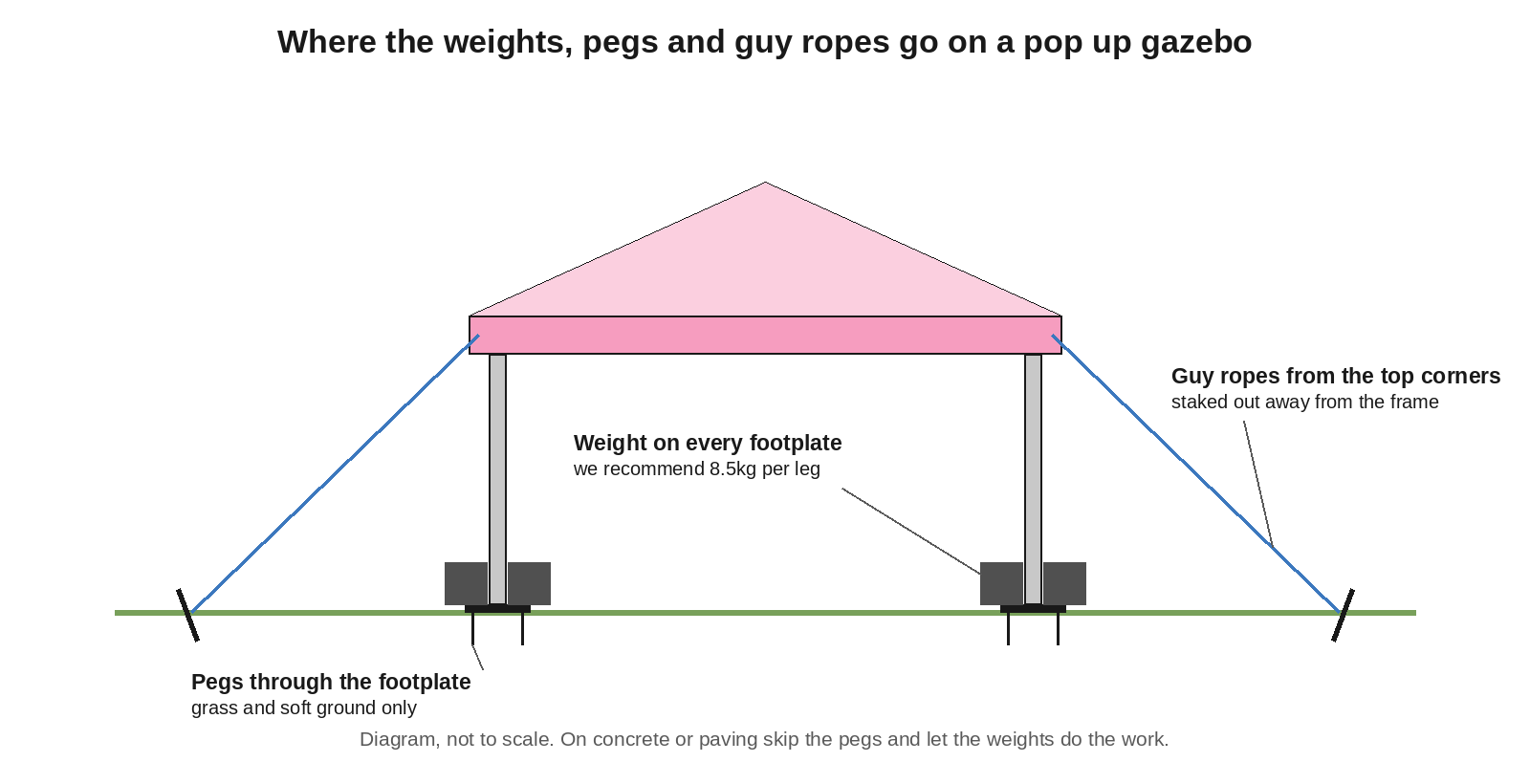
Many of our kits include a pack of ground pegs and guide ropes, listed under Kit Includes on each product page. Peg each foot through its footplate, then run the ropes out from the top corners and stake them at an angle away from the frame. Some sites restrict where you can drive pegs in, so read the event information before you arrive.
Sandbags and canopy weight bags
Each of these is a fabric sandbag that wraps round the leg and is filled with sand or gravel on site. It saves carrying the weight to the event, but a part-filled sand bag weighs far less than you think. Fill each one to the same weight you would use for a solid block, and fix it with its strap so it cannot slide down the leg.
Water weights
Fillable water weights are light to carry when empty, which suits a pitch you have to walk to. Water is bulky for its weight, though. At about 1kg per litre, you need roughly 8.5 litres in each leg to match one concrete block, so only rely on them where there is a tap nearby.
Improvised weights such as a brick or a gym weight plate are hard to fix to a leg, so they are better replaced with weights made for the job.
How to weigh down a gazebo on concrete
On concrete, tarmac, paving or a patio you cannot use pegs, so the weights do all the work. Follow these steps in order:
- Put the frame up to full size and fit the canopy before you add any weight, so you are not lifting a weighted leg.
- Sit a weight on each footplate, as close to the leg as it will go.
- If the venue lets you use a fixed point such as a fence post or barrier, tie the guy ropes off to it.
- Check every weight again once the walls are on.
Ratchet straps are handy for holding a weight tight to the leg so it cannot slip, rather than as the anchor itself.
How to secure a gazebo from wind on grass
Grass is easier because you can combine methods. To secure your gazebo on grass, weigh every leg first, then pin each foot and run out the ropes. Soft or wet ground grips pegs less firmly, so make sure the weights sit flat on the footplates rather than relying on the pegs. On a slope, set the legs to the height that keeps the roof level before you add the weights, as our Pro 40 frames are height adjustable.
How much wind can a gazebo withstand?
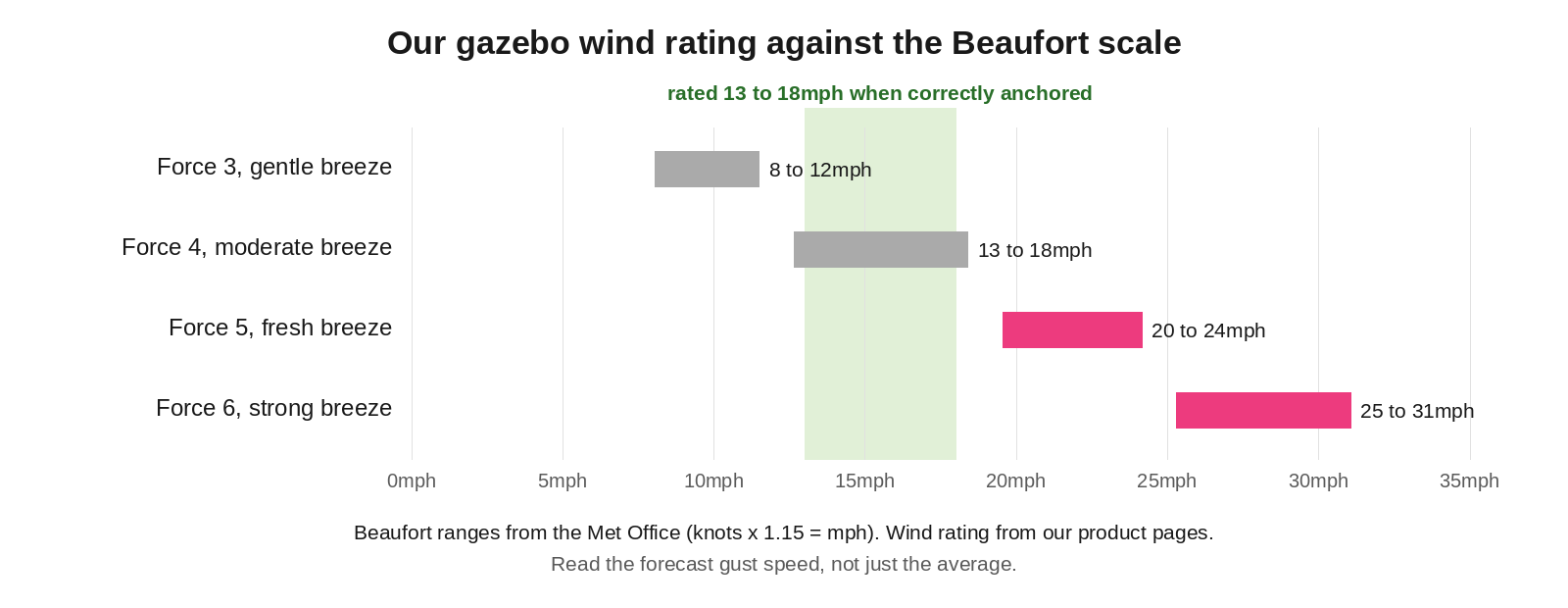
Every kit on our site has a published capacity of 13 to 18mph when correctly anchored. The rating on a pop-up frame assumes weights on the legs and pegs and ropes where the ground allows, not a frame standing on its own feet.
For context, the Met Office Beaufort scale gives force 4, a moderate breeze, as 11 to 16 knots, roughly 13 to 18mph using the Met Office factor of 1.15. Force 5, a fresh breeze, is 17 to 21 knots, about 20 to 24mph, which is already above the rating. So use these rules:
- Forecast gusts within 18mph. Weigh every leg and use the pegs and ropes too.
- Forecast gusts above 18mph. The frame is beyond its rating, so do not put it up, or take it down before the wind arrives.
- Not sure? On a windy day, read the gust speed, not just the average, as a forecast can show a calm average with stronger gusts.
Walls, curtain panels and stability in the wind
Walls give moving air more area to push against, so a fully walled frame needs at least as much weight on the legs as an open one for the same stability. Fix every wall and curtain to the legs with its straps so nothing works loose or flaps, and check the weights again after the walls go on.
Pop up gazebo or larger tent
This guide covers pop up gazebos. Larger structures such as a marquee or our Star Tent range are a different build, so follow the anchoring instructions supplied with them rather than the figures here.
Choosing outdoor gazebos that are easy to anchor
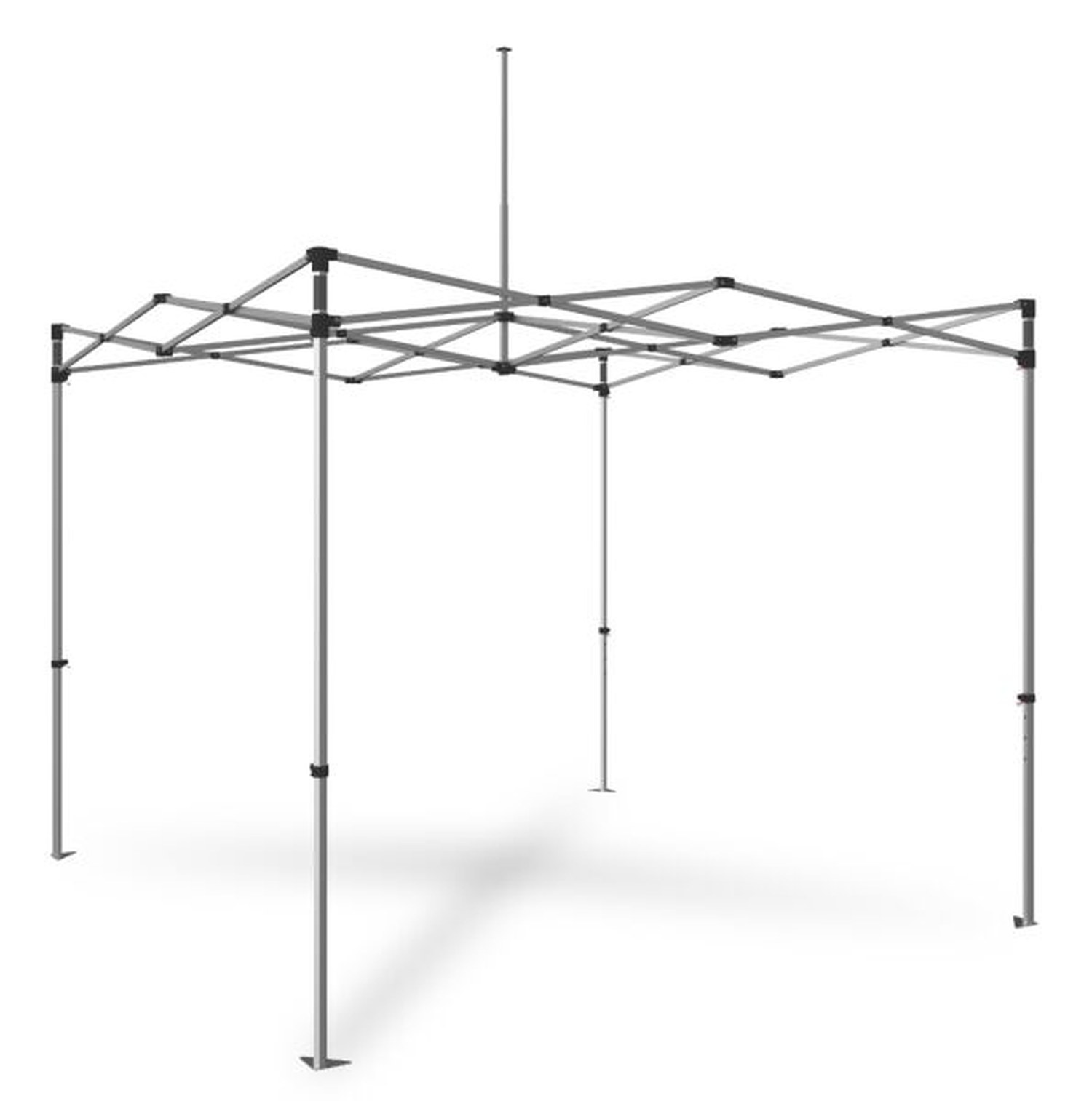
Our printed gazebos such as the Standard Pro, Vision and Event Pro kits use a Pro 40 hexagonal aluminium frame with height adjustable legs and footplates for pegs and weights. When you choose:
- The Standard Pro 3m x 3m kit (from £805.95 ex VAT) is a printed canopy with a tablecloth, ground pegs, guide ropes and a wheeled carry bag.
- The Vision 3m x 3m kit (from £1,205.95 ex VAT) adds a printed back wall, two half walls and a trestle table.
- The Event Pro 3m x 3m kit (from £2,101.95 ex VAT) adds two printed curve flags with small water bases and a printed counter. Those bases are for the flags, so you still need leg weights.
- Leg weights are sold separately, so add four to your basket for a 3m x 3m.
For a full branded setup rather than a single shelter, see our outdoor exhibition stands. Every order comes with free artwork design or proofing from our design team, and UK delivery is free on orders of £200 or more.
Printed and dispatched within 5 days with express options available.
Frequently asked questions
Do you need weights for a gazebo?
Yes. A pop up frame is light aluminium under a large canopy, and its wind capacity only applies when it is correctly anchored. Pegs and ropes help on grass, but weights work on every surface and are the only option on concrete or paving, so treat them as part of the kit rather than an extra.
How much weight do I need to hold down a gazebo?
For our frames the recommendation is one 8.5kg concrete weight on each leg. A 3m x 3m has four legs, so that is 34kg in total, or two packs of our leg weights. On grass, use the pegs and guy ropes as well as the weights, not instead of them.
What is the cheapest way to make gazebo weights?
Bags or containers filled with sand, gravel or water can work, as long as each one weighs at least as much as the weight you would otherwise put on each leg. Weigh them on scales before the event and strap them firmly to the leg so they cannot slip or swing.
How do you weigh down a gazebo on a patio?
A patio is hard ground, so pegs are out. Put the frame up first, then sit a weight on each footplate, close to the leg. If the venue allows it, tie the guy ropes to a fixed point such as a fence post. Check the weights again once any walls are fitted.
Are water weights good enough for a gazebo?
They can be, if they hold enough. Water weighs about 1kg per litre, so each one needs to be filled with water to roughly 8.5 litres to match one 8.5kg concrete weight. They are lighter to carry when empty, but you need a tap near the pitch and a check of the fill level before the event opens.