FREE UK delivery on orders of £200 or more

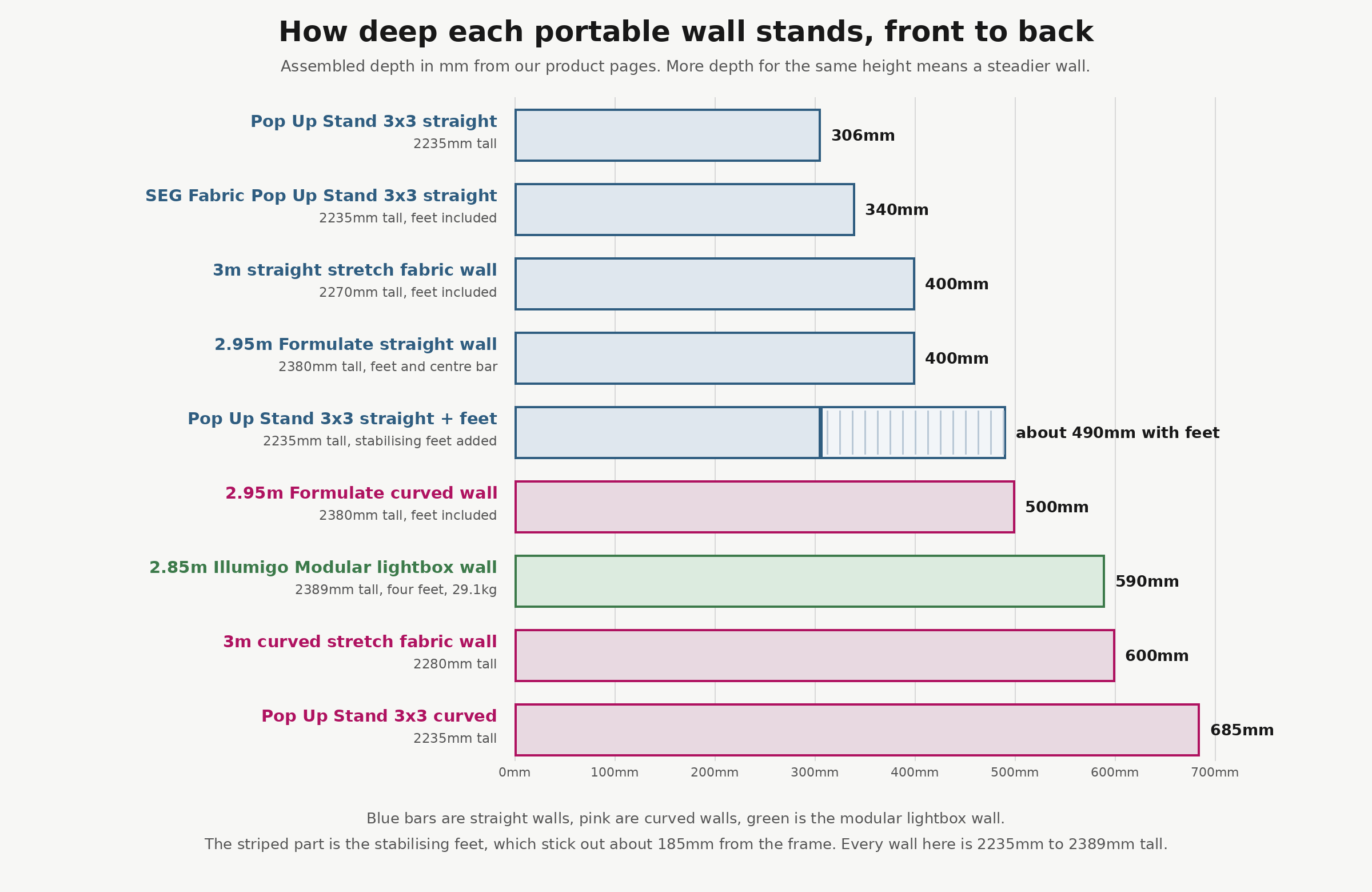
The best portable exhibition wall for stability is the one with the deepest footprint for its height. In our range that means a curved wall, a straight one with stabilising feet, or a modular system whose sections lock together on heavy feet. A curved pop up stands 685mm deep, a 3m curved stretch fabric wall 600mm and an Illumigo Modular lightbox 590mm on four feet, while a straight pop up is only 306mm deep and is the one to add feet to.
A busy show floor is hard on any display. As an exhibitor you will have visitors brushing past it, leaning on it to chat and hanging bags on it, and trolleys knocking it during build up. Below I go through what keeps a portable wall upright, then which of our systems suits which stand. Every size and price comes from our own product pages, prices are ex VAT, and they were checked on 23 November 2026.
Which portable exhibition wall is most stable
The most stable portable exhibition wall is a curved one, because the curve gives it depth without extra parts. Straight walls can be just as steady once they have proper feet, and a modular system is the steadiest option for long runs and heavy graphics. The table sets the main options side by side.
| Option | Depth and height | Price from |
|---|---|---|
| Pop Up Stand 3x3 curved | 685mm deep, 2235mm tall | £703.95 ex VAT |
| 3m curved stretch fabric wall | 600mm deep, 2280mm tall | £374.95 ex VAT |
| 2.85m Illumigo Modular lightbox | 590mm deep, 2389mm tall, 29.1kg | £1462.95 ex VAT |
| 2.95m Formulate curved fabric wall | 500mm deep, 2380mm tall | £540.95 ex VAT |
| 3m straight stretch fabric wall | 400mm deep, 2270mm tall | £419.95 ex VAT |
| SEG Fabric Pop Up Stand 3x3 straight | 340mm deep, 2235mm tall | £620.95 ex VAT |
| Pop Up Stand 3x3 straight | 306mm deep, 2235mm tall | £703.95 ex VAT |
| Pop up stabilising feet (pair) | Stick out about 185mm, 1.2kg | £55.95 ex VAT |
Every portable display option in that table is between 2235mm and 2389mm tall, so height hardly separates them. What does separate them is how far the base reaches front to back, whether it has feet that spread the load, and how the structure is braced. Those are the things worth reading on any product page before you buy.
What keeps a portable wall system upright
A portable wall system stays upright when its base reaches far enough front to back that a push near the top cannot tip it past its feet. That comes down to five things, and you can check all of them on a product page.
- Depth for its height. A wall that is 2.2m tall but only 300mm deep needs very little push near the top to tip, while the same one 600mm deep needs a lot more. This is the single biggest factor.
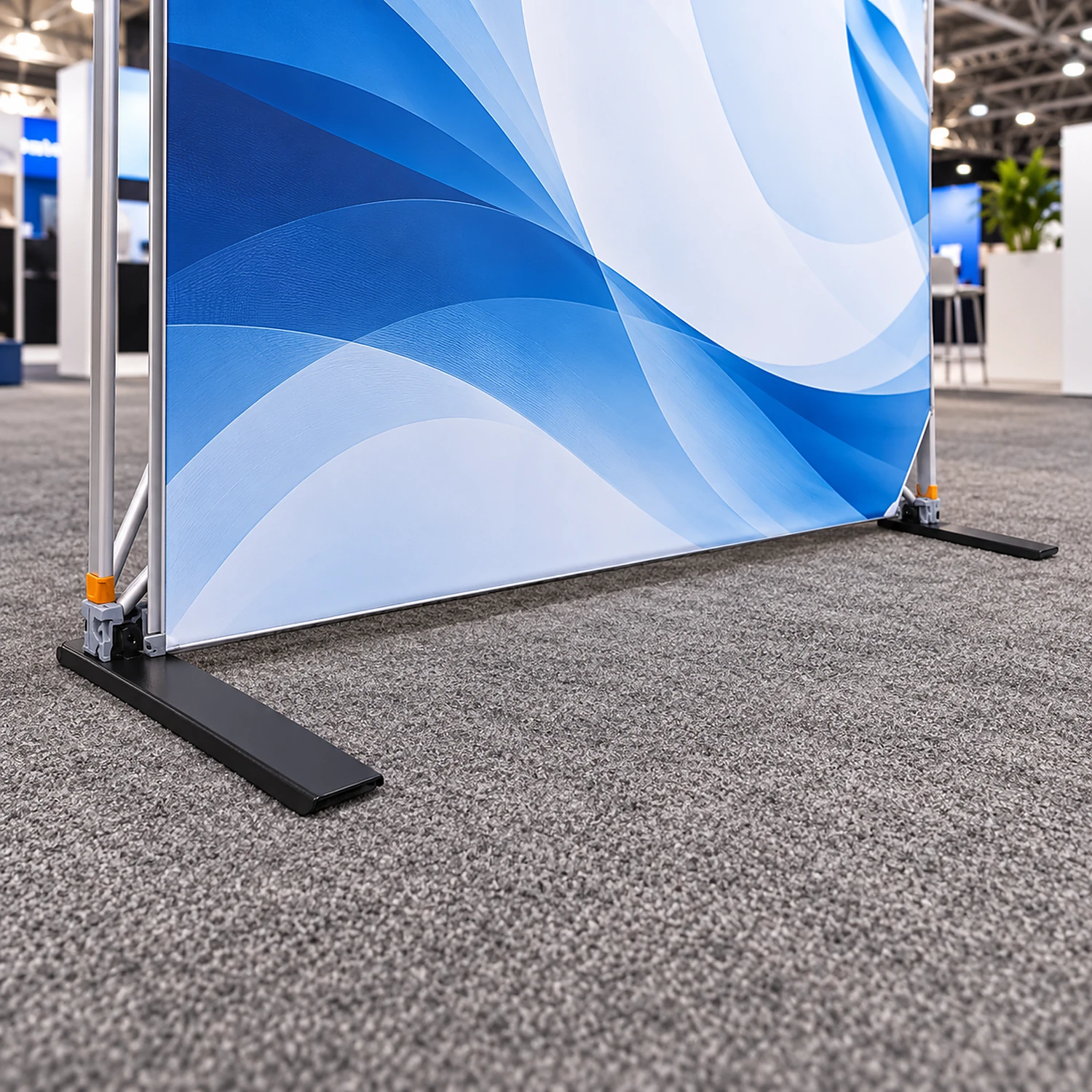
- Feet. Feet spread the base out and give the structure something to stand on other than the edge of the graphic. On our straight stretch fabric and Formulate walls they fix on with the allen key supplied at installation, and add on stabilising feet do the same job on a pop up.
- Bracing. A structure braced across its middle, such as the central support bar on our Formulate range, flexes less than an open one, so it stays square when someone leans on it.
- Shape. A curve or a corner turns a flat panel into a shape that stands on its own, which is why a curved wall needs no extra parts to be steadier.
- Joining. Sections joined into an L or a U brace each other, so a modular system gets steadier as it grows.
Weight helps too, but less than you might think. Weight low down in the base is useful, while weight up in the graphic or a screen makes a display top heavy. A lightweight fabric wall with good feet can be steadier than a heavier panel standing on a narrow base.
Straight pop-up and fabric walls, and when to add feet
A straight portable wall is stable enough for most stands once it has feet, and our stretch fabric and Formulate straight walls come with them. A straight pop up is the exception. At 306mm deep it is the shallowest option here, so add stabilising feet if it will carry a screen or stand where people will lean on it.
Our pop up stand stabilising feet are £55.95 ex VAT for a pair. They stick out about 185mm from the edge of the frame, weigh 1.2kg together and are designed for flat fronted frames and frames with a screen, which are the two set ups most likely to rock. Fitted to a straight 3x3 pop up, they take the base from 306mm to about 490mm front to back, close to a curved Formulate wall.
If budget matters more than lights and a case, the Lite Pop Up Stand 3x3 straight has the same 2.7m wide, 306mm deep structure from £538.95 ex VAT, with graphic panels printed on semi-rigid 500 micron material. The same advice on feet applies to it.
Straight stretch fabric walls work differently. The fabric graphic pulls over a lightweight aluminium tube structure and zips shut underneath, and the feet fix on with the allen key supplied. Our 3m straight stretch backdrop stands 400mm deep and 2270mm tall, from £419.95 ex VAT, and the same version comes in widths from 1m (from £245.95) to 6m (from £772.95), all 400mm deep.
The Formulate straight range goes a step further. The 2.95m version is 400mm deep and 2380mm tall, with stabilising feet included and a central support bar that keeps it rigid, from £559.95 ex VAT. Push button joints lock each tube section during assembly, which helps it stay square through a long show. My guide to a fabric wall vs pop up wall covers the wider differences between the two.
Curved designs stand steadier in the same space
A curved wall is steadier than a straight one of the same width because the curve spreads it front to back. You get the extra depth from the shape itself, with nothing to add and nothing extra to carry.
The figures make the point. Our 3m straight stretch fabric wall is 400mm deep, while the 3m curved stretch fabric display is 600mm deep and costs less, from £374.95 ex VAT. The 6m curved version stands 1200mm deep. With pop ups the gap is bigger again. The straight Pop Up Stand 3x3 is 306mm deep and the curved Pop Up Stand 3x3 is 685mm deep, both from £703.95 ex VAT with a wheeled case that turns into a counter and two LED lights.
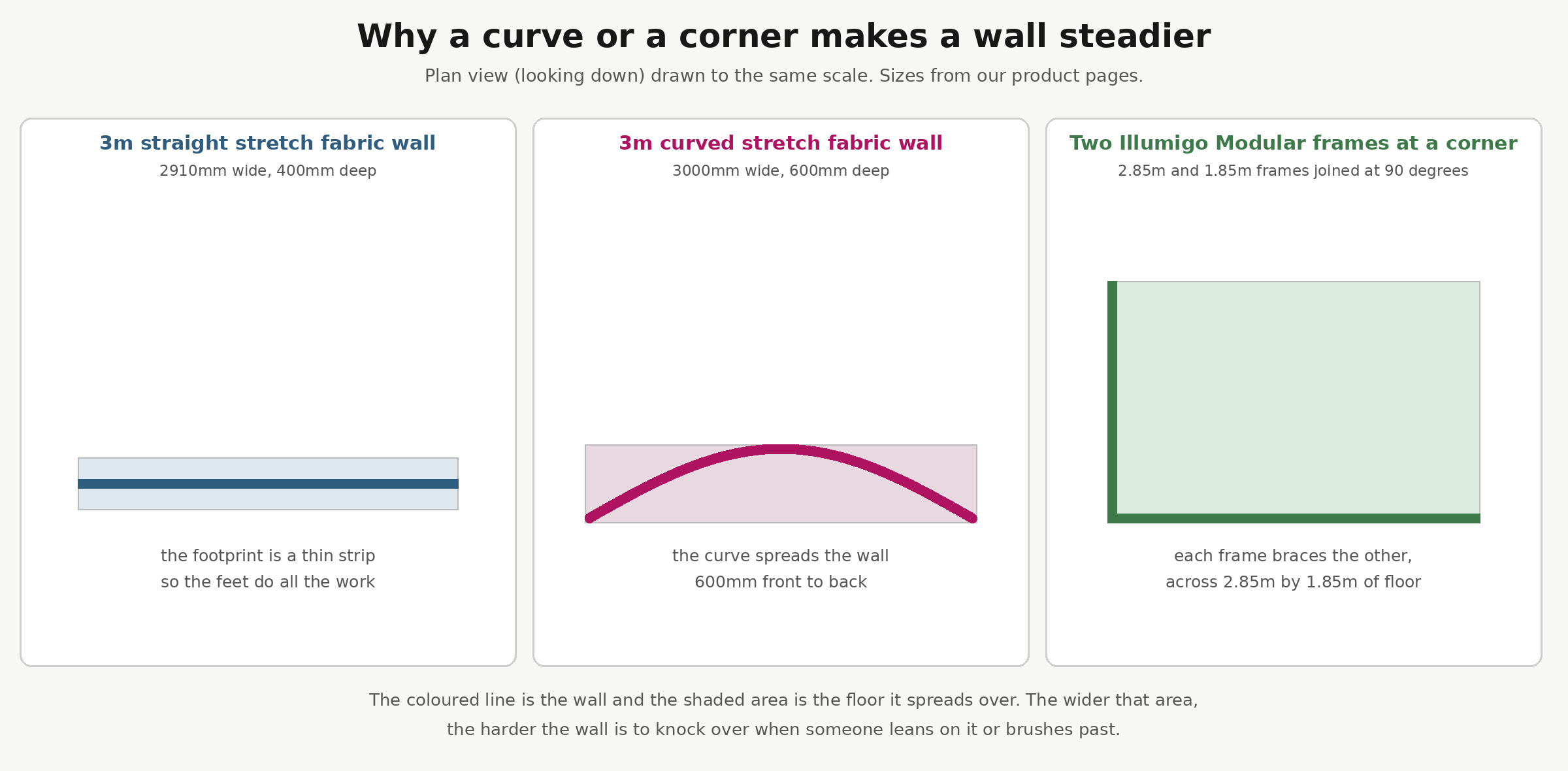
The trade off is space. A curve takes more depth out of your stand, so on a 3m by 2m stand a 685mm curve uses about a third of the depth before you add a counter. If your stand is shallow, a good alternative is a straight wall with feet, which keeps more room for visitors. In a deeper space or on an island, a curve gives you a steadier wall that also draws people in.

Modular wall and tension fabric systems for long runs
A modular wall system is the steadiest choice for long runs, corners and lit walls, because each section stands on its own feet and the sections lock together. The longer the run, the more each section braces the next.
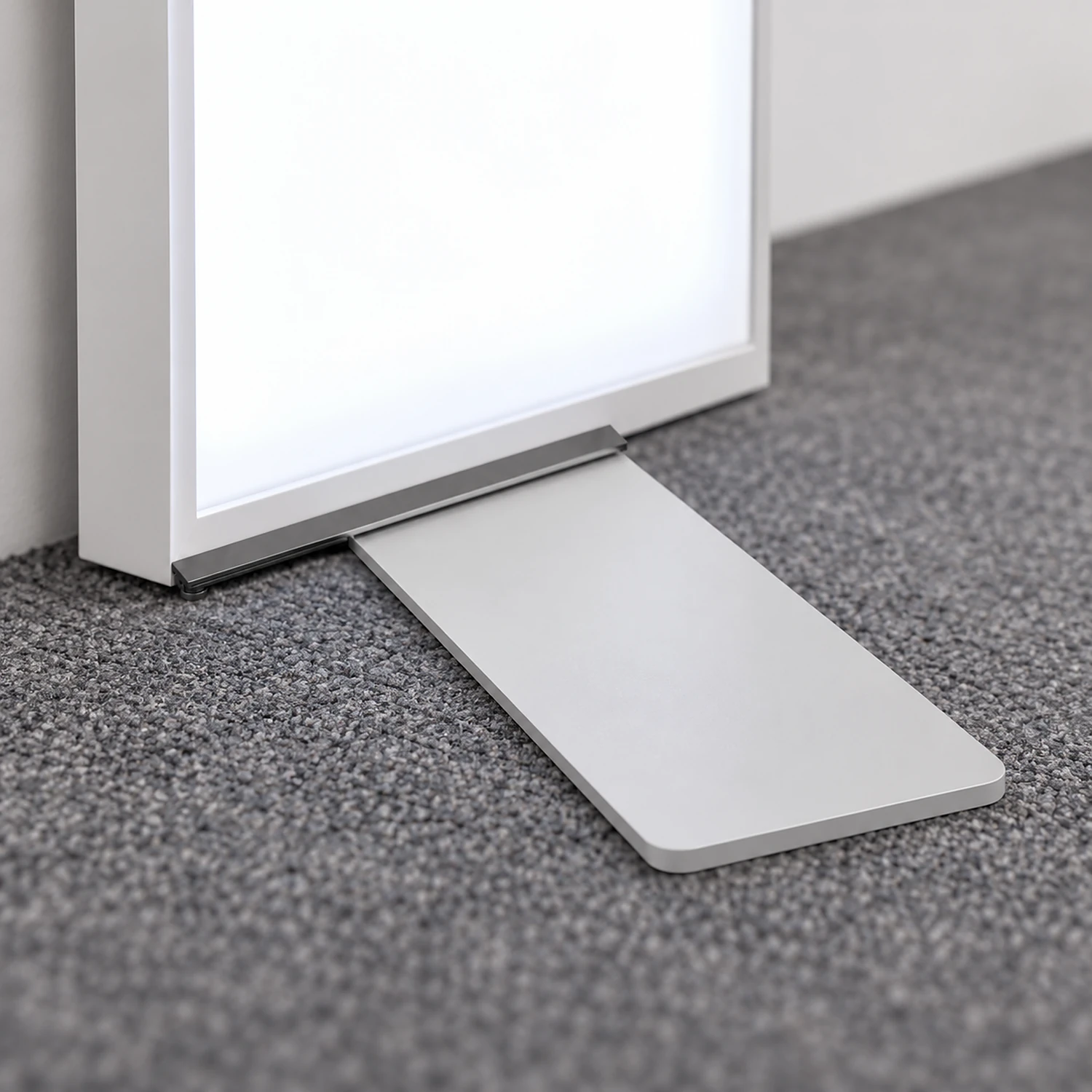
Our Illumigo Modular freestanding LED lightbox is the heaviest example. The 2.85m version is 590mm deep and 2389mm tall, weighs 29.1kg and stands on four feet fixed with thumbscrews, with internal reinforcement tubes in its 120mm deep aluminium profile. It is from £1462.95 ex VAT, and the range runs from 1.85m (from £1179.95) to 5.85m (from £2558.95), with 850mm and 1m extensions to grow it.
The add ons are all about how the system stands. Corner connectors (£51.95 for a set of four) stiffen a right angle join on three sided and multi section layouts. A blind foot (£44.95) replaces one foot where two sections meet at a corner so it closes up neatly. A half foot (£46.95) is 360mm deep, so a lightbox can stand right against a venue wall in a small space.
Tension fabric portable wall systems work the same way at a lighter weight, allowing you to build a larger exhibition layout from small sections. Each WaveLine Display Wall comes with two single edge feet and a lifetime warranty on the hardware, and the modular design lets you change the layout to suit different spaces. If you want something you can reuse in different shapes from show to show, my guide to the best reusable exhibition stand for multiple events covers which systems are designed for repeated use and best to take from one event to the next. That flexibility is what makes a modular system a good investment if your company exhibits at several types of exhibition a year, because the same parts can be set up in a different setting each time.
Choosing a display design for your event and stand size
Choose by how busy the floor is, how deep your space is and what the wall has to carry. These lines cover most stands.
- Best for: busy aisles on a standard stand. A curved stretch fabric wall, 600mm deep at 3m, from £374.95 ex VAT.
- Best for: shallow stands where depth is tight. A straight stretch fabric or Formulate wall at 400mm deep with its feet fitted.
- Best for: a pop up kit with a screen. A straight pop up with stabilising feet added, or a curved pop up at 685mm deep.
- Best for: long runs, corners and lit walls. An Illumigo Modular lightbox on four feet with corner connectors.
- Best for: one narrow graphic beside the main wall. A freestanding SEG fabric display on its own feet, from £231.95 ex VAT double sided at 1m by 2m, rather than a roller banner squeezed into a corner.
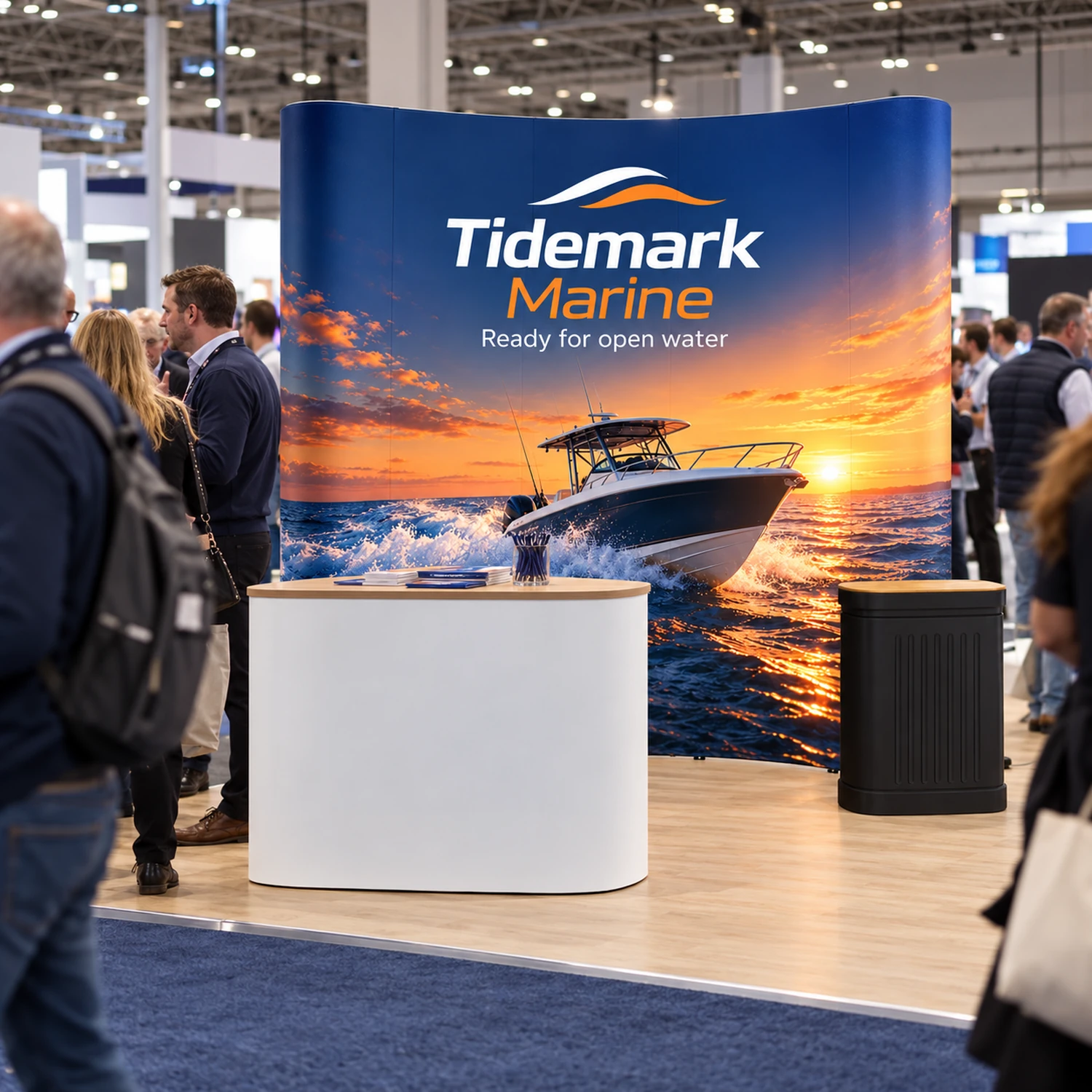
If you are still choosing between types, the full range of portable exhibition walls is in one place, and my round up of the best portable exhibition stands for small businesses covers the wider range of portable display options for small exhibition spaces. We can also make custom sizes and configurations to fit your space, so if no standard size is the right solution, tell us what you need and we will put together a quote.
Set up, transport and storage for a steady show stand
Most wobble comes from set up rather than the product itself, so a few minutes of checks at build up make a real difference. These follow the instructions on our product pages.
- Fit every foot. On stretch fabric walls the feet fix on with the allen key in the kit, and on Illumigo sections they are held with thumbscrews. A missing or loose foot is the usual reason a wall rocks.
- Check the floor. Venue floors are not always level. Our SEG Fabric Pop Up Stand comes with stabilising feet to keep it steady on uneven floors.
- Lock every joint. On the Formulate range each tube joint clicks home with a push button, so check them all before the graphic goes on.
- Keep heavy items low. A screen or shelf high up makes a display top heavy, so use stabilising feet or a structure made to carry one.
- Join sections where you can. Two sections at a right angle brace each other, and the SEG Fabric Pop Up Stand can stand side by side or at right angles with other units to make a bigger display.
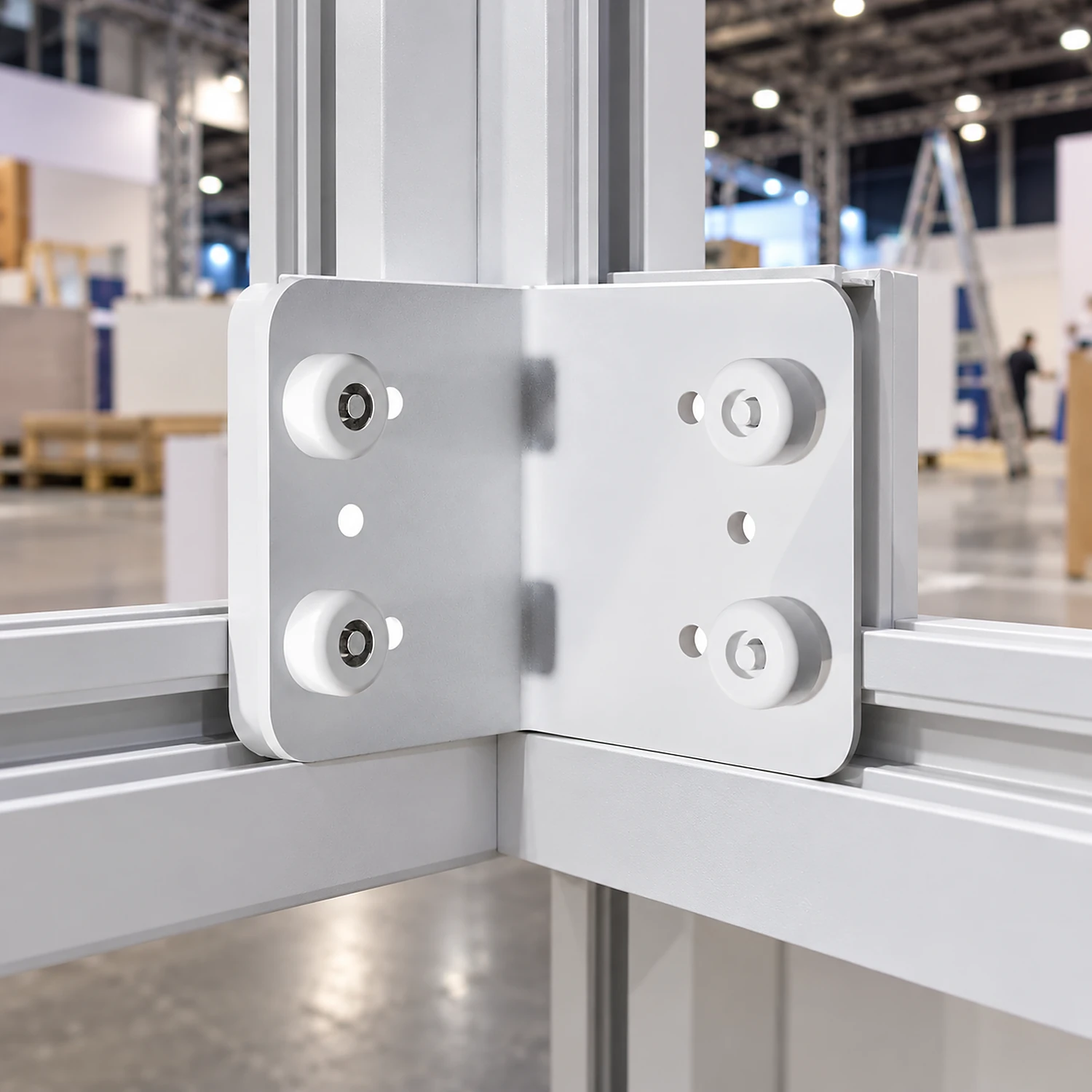
Transport and storage matter as much as set up, because a bent tube or a missing foot is what makes a wall rock at the next show. The full pop up kits pack into a wheeled case, the Illumigo range into a wheeled bag with foam inserts, and the stretch fabric and Formulate walls into a carry bag with the feet and allen key, so keep the feet with the kit when you store it. The fabric graphics can be washed, and a new graphic can go on the same structure whenever your message changes.
Double sided graphic walls and free artwork
If the wall will stand out in the open rather than against the back of your space, choose a double sided graphic, because that is also where stability matters most. A wall away from the back of a stand has people passing on both sides, so both faces should look finished and the feet should be fitted properly.
On our stretch fabric walls both faces are printed by dye sublimation, and you can use the same design on each side or a different one on each at no extra cost. The 3m curved version is from £419.95 ex VAT double sided against £374.95 single sided. A second face is a good place for your brand on one side and a product message on the other.
Whichever you choose, every order includes FREE artwork design or proofing, so we check your file before it prints or our team designs it for you, ready to fit onto the wall frame. The artwork guidelines cover the file setup, and there is FREE UK delivery on orders of £200 or more.
How we compared
This is a desk comparison of published product information, not a test of the products. I compared the assembled width, height and depth, weight, feet, bracing and price on our live product pages for the Pop Up Stand, Lite and SEG Fabric pop ups, straight and curved stretch fabric walls, the Formulate range, WaveLine Display Walls, freestanding SEG fabric displays and Illumigo Modular lightboxes with their feet and connectors, all checked on 23 November 2026.
Frequently asked questions
Are fabric exhibition walls stable?
Yes, as long as the feet are fitted. Our stretch fabric walls stand 400mm deep straight and 600mm deep curved at 3m, and the Formulate range adds a central support bar. The fabric itself is light, so most of the weight sits in the structure and feet, low down.
Do pop up stands need stabilising feet?
A curved pop up stands 685mm deep and is steady on its own. A straight pop up is only 306mm deep, so stabilising feet are worth adding if it carries a screen or stands where people lean on it. Our pair is £55.95 ex VAT and sticks out about 185mm.
Is a curved wall more stable than a straight wall?
Yes. The curve gives the wall depth front to back without any extra parts. Our 3m curved stretch fabric wall is 600mm deep against 400mm for the straight version, and the curved Pop Up Stand 3x3 is 685mm deep against 306mm straight.
Can you join portable exhibition walls together?
Yes, and joined sections brace each other. Illumigo Modular lightboxes join with extensions and corner connectors, WaveLine Display Walls are modular, and the SEG Fabric Pop Up Stand can stand side by side or at right angles with other units.