FREE UK delivery on orders of £200 or more
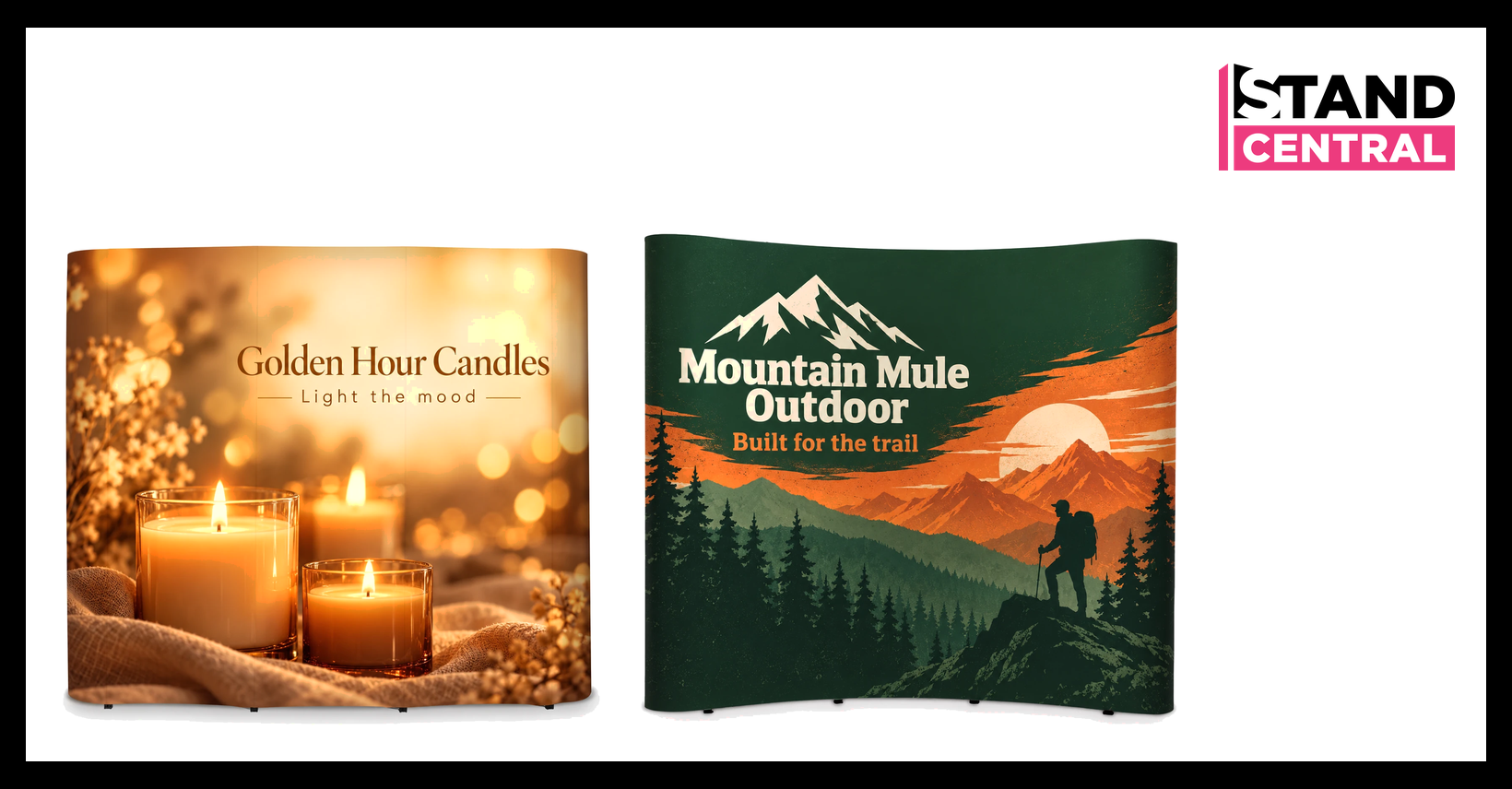
If you are weighing up a curved vs straight pop up stand, the short answer is that straight is the better pick for a shallow plot, a narrow space or a stand where you want the widest possible graphic, and curved is better when you have some floor depth to spare and want a softer backdrop that wraps round the people on your stand. In most ranges the two shapes cost exactly the same, so the decision comes down to your space and how you want the stand to feel.
I have used products from our own range for every figure below so you can compare like for like. Prices are ex VAT and were checked on our live product pages on 30 October 2026.
Curved or straight pop up display stand at a glance
| Straight | Curved | |
|---|---|---|
| Floor depth | 306mm | 485mm to 960mm |
| Graphic width | Widest | A little narrower |
| Best plot | Shallow or tight | Open or deeper |
| Feel | Flat backdrop | Wraps round you |
| Price | Same | Same |
Price is the part people expect to differ, and it usually does not. In the Impact range the straight 3x3 pop up stand and the curved 3x3 pop up stand are both £539.95, the 3x2 sizes are both £457.95 and the 3x4 sizes are both £648.95. The double sided pop up stands match too, at £649.95, £815.95 and £1027.95. The same is true of our Vision Value walls and the Vision kits where the case converts to a counter, so you are not paying extra for the curve.
How much floor a curved pop up stand takes
This is what decides it on most stands. A straight frame is only as deep as the frame itself, which is 306mm on every straight size in the Impact range. It sits flat against the back of the plot and leaves the rest of the floor for you and your visitors.
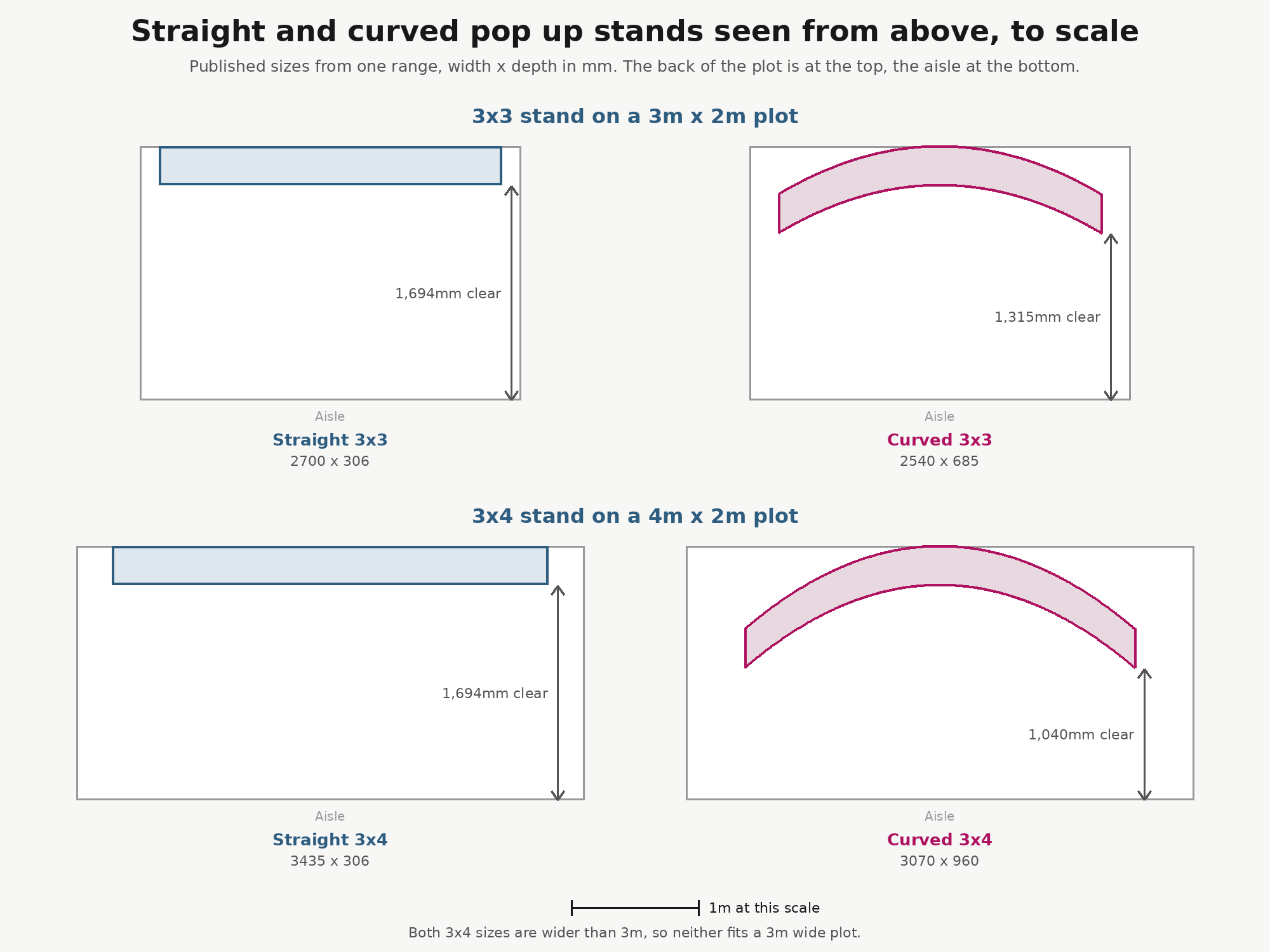
A curved frame needs extra depth for the curve. The curved 3x2 is 485mm deep, the curved 3x3 is 685mm deep and the curved 3x4 is 960mm deep. On a 2m deep plot, that leaves 1,315mm of clear floor in front of a curved 3x3 against 1,694mm for the straight one. With a counter, a screen or a small queue at the front of the stand, those 379mm can be the difference between a comfortable space and a cramped one.
Width and graphic size at 3x2, 3x3 and 3x4
Curving a frame also pulls the ends in, so a curved pop up display is narrower than a straight one with the same number of panels. A 3x3 curved stand is 2,540mm wide against 2,700mm for the straight 3x3, and a 3x4 curved stand is 3,070mm wide against 3,435mm. The 3x2 curved stand and the straight 3x2 are almost the same at 1,930mm and 1,970mm. The height is 2,225mm for every size and shape, so only the width and depth change.
That matters in two ways. On a 3m wide plot, both 3x3 sizes fit with room to spare, but neither 3x4 does, because both are wider than 3m. On a 4m wide plot, the straight 3x4 gives you the biggest flat graphic, and the curved 3x4 gives you a slightly narrower one that reads as a single wrapped backdrop. If the plot is tight on width, the curve can help you fit a 3x4 where the straight one would not, as long as you have the depth for it.
If you are not sure which size suits your plot, my guide to the best exhibition stand for a 3x3 space goes through the options for the most common plot size.
Which shape works better for visitors at trade shows
A straight frame gives you a flat wall of brand. For a professional look on a busy aisle it is the easiest shape to line up with other straight displays, such as a counter at the front, banners at the side or a screen on the frame, and it works well on a plot that runs along an aisle or sits in a row of other stands. Your graphic reads the same from anywhere in front of it, which is useful when most people walk past rather than stop.
A curved frame faces in towards the middle of your space, so the people on your stand feel more enclosed and the backdrop looks bigger from the aisle than its width suggests. I think it works best on a corner or an open plot, where people can approach from more than one side, and for conversations or demos where you want visitors to step in rather than talk across the aisle. It also softens a room full of straight walls, which helps a small stand get noticed at busy trade shows.

Printed graphics, artwork design and the template for each shape
Both shapes use the same kind of printed graphic panels that hang on the pop up frame and fix with magnetic bars, so the artwork process is the same. The difference is in how you lay it out. On a straight frame, the graphic is flat, so text near the edges stays as easy to read as text in the middle. On a curved frame, the outer panels turn towards the centre, so keep your logo, headline and website in the middle panels and use the outer panels for colour, imagery or a short supporting line.
Every order includes FREE artwork design or proofing. You can send us your own artwork to check before print, or our team will design it for you. The artwork guidelines cover the file setup, and each product has its own template supplied as a download. There is also FREE UK delivery on orders of £200 or more.
Transport, stabilising feet and set up
Shape makes very little difference here. The Impact frames are aluminium with magnetic locking arms, they assemble without tools and they come with a wheeled carry case for both shapes. Our Pop Up Stand range has the same curved and straight options at the same price (£703.95 for a 3x3), with a wheeled case that converts to a counter, two LED lights on the 3x3 and a set up time of about 15 minutes. So a curved pop up stand is no harder to transport or put up than a straight one.
The one place the shape changes the kit is a lightweight fabric frame. In the Soft Touch range, the 3m straight fabric display comes with stabilising feet, while the 3m curved one is listed as not needing them. I think that is because the curve does the same job and keeps it standing. The shipping weight is almost the same (6.5kg and 6.4kg), so both are easy portable options, and the curved 3m Soft Touch display is actually the cheaper of the two at £359.95 against £388.95.
Counter, lights and other accessory choices
Most of the extras work with either shape, but it is worth checking before you order. The Quick+ bundles come with a case that converts to a counter and two LED spotlights, and the curved 3x3 bundle is £747.95 against £757.95 for the straight one. The Vision kits with a TV mount are the same price in both shapes (£1254.95 for a 3x3) and take a 20 to 50 inch screen. If you want to add a screen to a stand you already own, our separate screen mount is made for straight pop up stands, so a flat frame gives you more options later.
A counter in front of a curved frame also needs a little thought about the event layout. The ends of a curve come forward, so the counter usually sits in the middle of the curve, where the frame is furthest back. On a straight frame you can put it anywhere along the front.
Curved vs straight fabric wall or PVC pop up
The shape question comes up in fabric and PVC ranges alike. Our Vision Value walls are designed with 550 micron PVC panels as the graphic material, are B1 fire rated and carry a 5 year frame warranty (excluding the graphic), and the curved and straight versions are the same price at every size from £463.95 for a 3x2. The curved Vision Value 3x3 is 2,540mm wide and 685mm deep, the straight one 2,700mm wide and 306mm deep, the same as the Impact sizes.

In our Textile fabric pop up stand range the gap in width is much smaller. The curved 3x3 is 2,250mm wide and the straight 3x3 is 2,260mm, both £524.95, and the fabric is machine washable at 30°C. At 3x4 the curved one is £638.95 against £629.95 for the straight one. If you want a fabric pop up stand and your plot is tight on width, the shape costs you almost nothing in graphic size.
You can compare every curved model in our curved display wall range and every flat one under straight display walls, or see complete kits under pop up stands. If you are still deciding on the type of stand, see my comparison of a pop up stand vs modular stand.
Which shape to buy for your exhibition
- Choose a straight pop up stand if your plot is 2m deep or less, it runs along an aisle, or you want the widest flat graphic for the number of panels.
- Choose a curved pop up stand if your plot is open on two sides or deeper than 2m, and you want visitors to step on to the stand rather than talk across the aisle.
- Choose straight if you plan to add a screen, a counter and banners in a line, because flat panels make the simplest layout.
- Choose curved if you need a 3x4 graphic on a plot that is a little short of the straight 3x4 width, as long as you have about 1m of depth for it.
If it is your first show and you are still unsure, I would lean towards straight. It fits more plot shapes, gives you more floor and works with almost any other display you add later. If you exhibit on open or corner plots most of the time, curved is the shape that makes the most of them. My guide to the best exhibition stand for a first trade show covers the rest of the kit, and the curved vs straight exhibition counter guide helps if you are matching a counter to your backdrop.

Frequently asked questions
Is a curved pop up stand more expensive than a straight one?
Usually not. In our Impact, Vision Value, Vision kit and Pop Up Stand ranges the curved and straight versions are the same price at almost every size. The small exceptions are the 1x3 Pop Up Stand, where the curved one is £42 more, and the Textile 3x4, where it is £9 more.
Does a curved pop up stand take up more space?
Yes, in depth. A straight frame in the Impact range is 306mm deep at every size, while the curved versions are 485mm, 685mm and 960mm deep for the 3x2, 3x3 and 3x4. Check the dimension on each product page against the depth of your plot and allow for anything you put in front.
Will a 3x3 pop up stand fit on a 3m wide stand?
Yes, both shapes do. The straight 3x3 is 2,700mm wide and the curved 3x3 is 2,540mm wide, so either leaves a little room at the sides. Neither 3x4 fits a 3m wide plot, because both are over 3m wide.
Can I use straight and curved displays together?
Yes. A curved backdrop with straight banners at the sides, or a straight wall with a curved counter in front, are both common layouts. Keep the main message in the middle of a curved graphic and line up the edges so the stand looks like one piece.