FREE UK delivery on orders of £200 or more
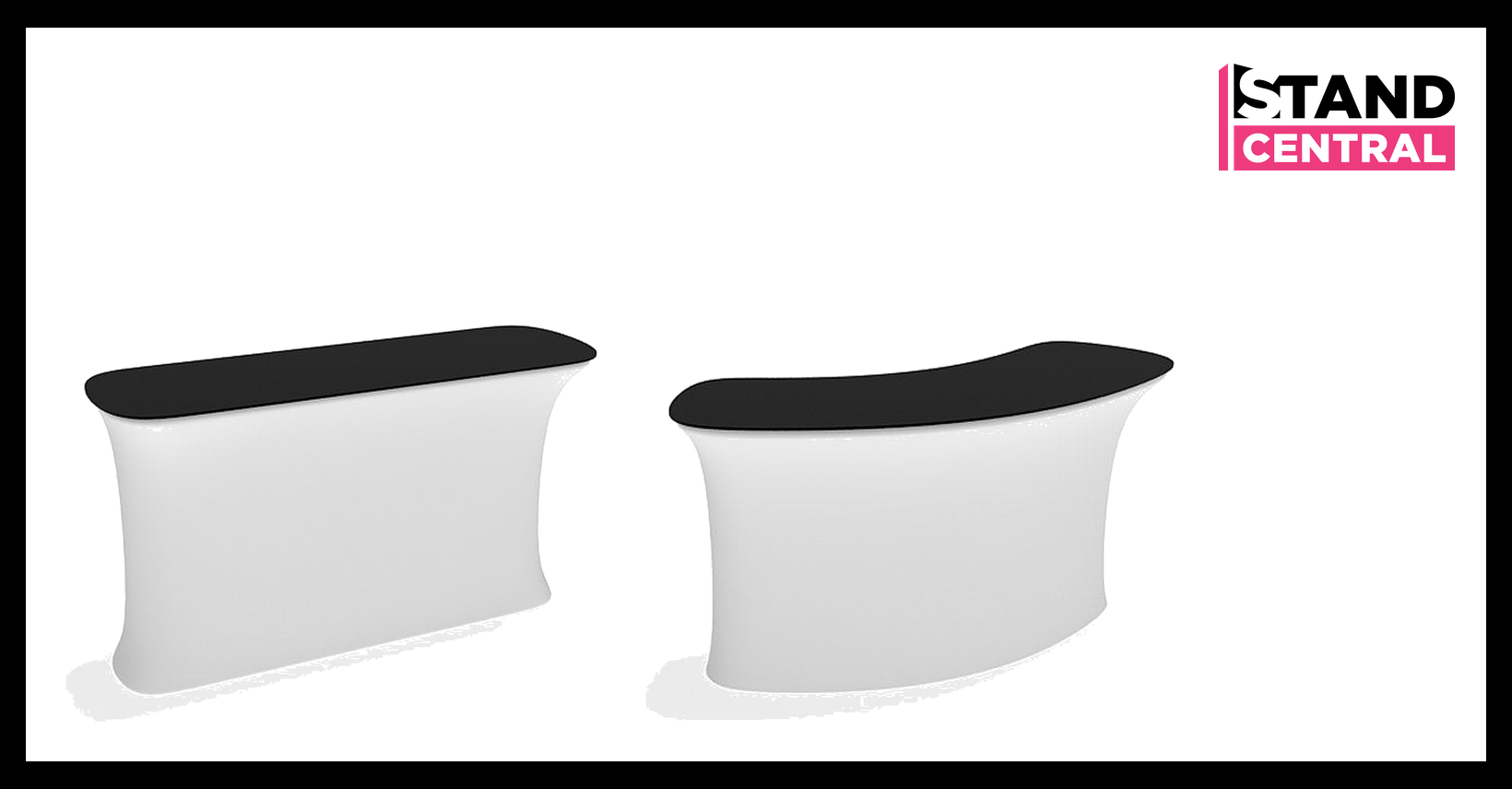
If you are choosing between a curved vs straight exhibition counter, the short answer is that a straight desk is the practical pick for a tight layout or a long welcome point, and a curved one is better when you want the front of your exhibit to feel open and you have the floor depth to spare. The shape changes how much room it takes, how much it weighs and how people approach it, so I would settle straight or curved before you look at the graphic.
I have used products from our own range for the figures below, so you can compare like for like. All prices are ex VAT and were checked on our live product pages on 29 October 2026.
How straight and curved display counters compare at a glance
| Straight | Curved | |
|---|---|---|
| Floor depth | Shallow | Deeper |
| Fits against | Walls, aisles | Open corners |
| Feel | Formal desk | Open, softer |
| Weight | Usually lighter | Often heavier |
| Graphic | Flat panel | Wraps round |
| Price | Similar | Similar |
Price is closer than most people expect. In the same range, the straight 1.74m model is £539.95 and the convex curved version of the same width is £533.95. At about 2.3m wide the straight model is £629.95, the convex curve £667.95 and the concave curve £680.95. So the choice comes down to room and layout rather than budget.
How much floor each shape needs
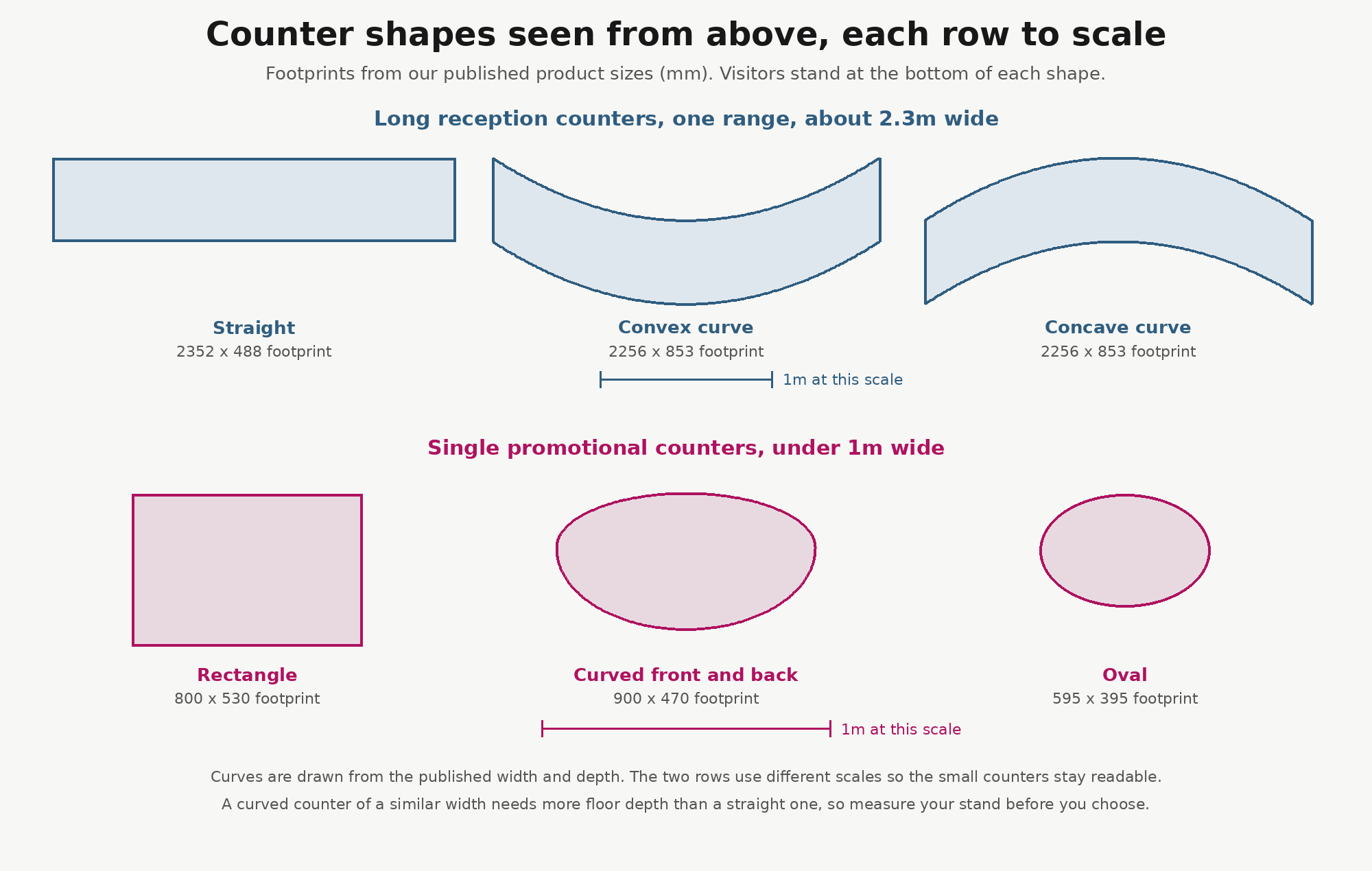
This is the point that decides it on most stands. A straight desk is only as deep as its top. The straight models above are 488mm deep at every width, so they sit neatly along the front of a space only plot or against a back panel without eating into the area where people gather.
A curved design needs extra depth for the curve itself. The convex 1.74m model is 683mm deep, and the 2.26m convex and concave versions are 853mm deep, which is about 365mm more than the straight one of a similar width. On a 3m x 2m plot that is a real chunk of space, so check the dimensions against your plan before you choose.
Which counter works better for visitors at a trade show or event
A straight model reads as a desk. That suits a reception or registration point, a demo where people stand on one side and your staff on the other, or a plot where the desk runs along the front as a clear edge. It is also the easiest one to line up with straight displays, such as walls and banners.
A curved front feels more welcoming because it has no hard front corner. A convex curve bulges outwards, so people can walk up to it from more angles and it catches anyone passing from either side. A concave curve does the opposite and wraps round the customer, which works well for a conversation or a product demo where two or three people face one member of staff. If your plot is open on two sides, curved displays on the corner usually look more natural than a straight one. At busy trade shows that open front also makes it easier for your staff to deal with a small queue.
Portable setup and transport
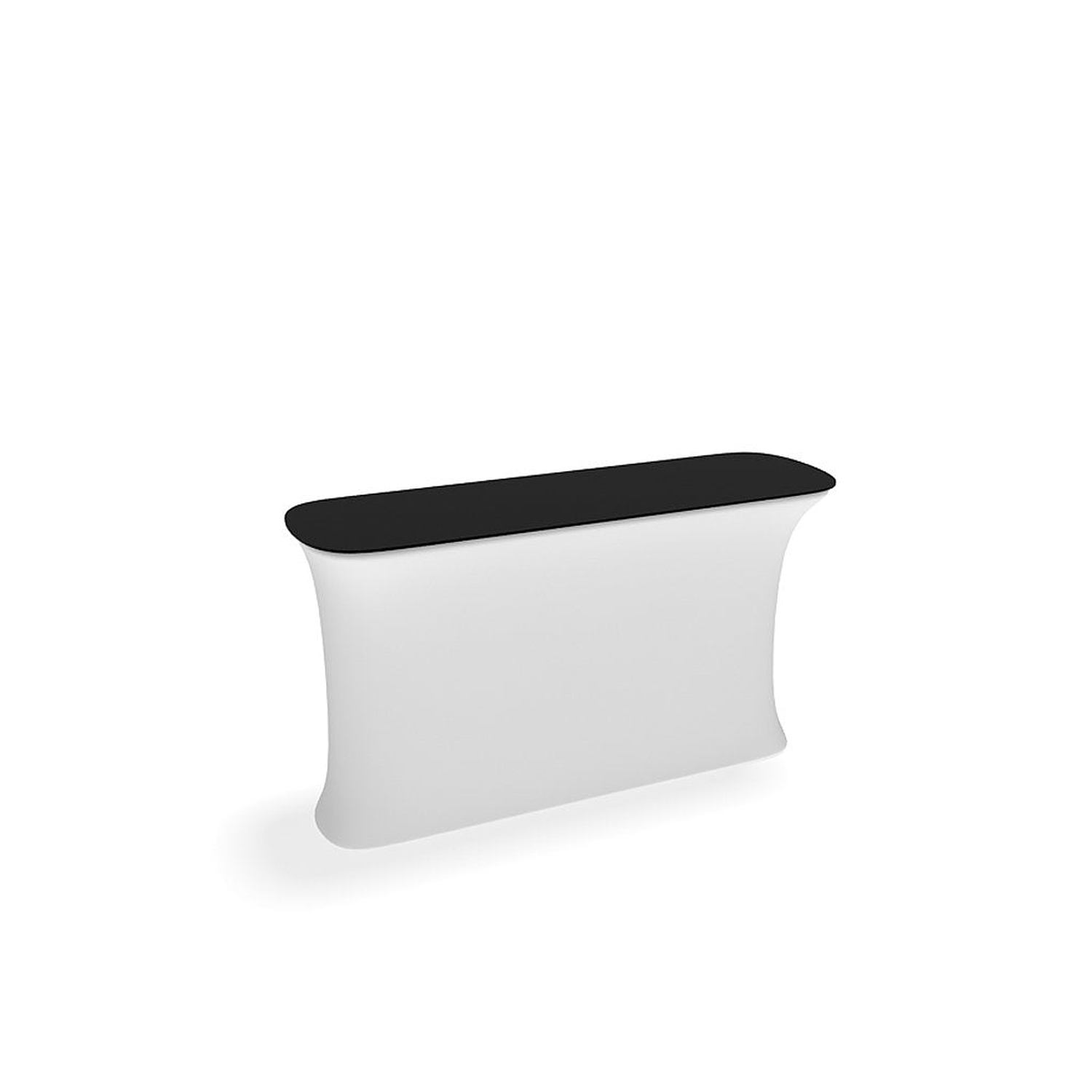
Straight models are often lighter. The 1.74m straight version weighs 5.9kg against 9.48kg for the convex curve of the same width, and both pack into carry bags. At 2.3m the straight and concave versions are both 7.3kg and the convex is 11kg. All of them use a lightweight aluminium frame system that supports a printed stretch fabric graphic and black tops, and assembly is tool-free. They are made for indoor use.
If one person carries everything to every show in a car, those few kilos matter. If it all goes in a van, the difference is much less important than the room it takes up.
Height is the same whichever you pick. The straight, convex and concave models in this range are all 1001mm high, and our single fabric models are between 926mm and 1020mm, so they all work as a standing height desk.
Mixing straight and curved shapes on one stand
You do not have to pick one shape for the whole exhibit. On a larger space only plot, a common layout is a straight desk along the main aisle for welcoming people and a small oval one near a corner for leaflets or a product demo. The straight one keeps the front tidy and the curved one breaks up the straight lines across the back.
Some models combine both in one piece. The J-shaped InfoDesk uses curved and straight frames to wrap round a corner, with a footprint of about 2967mm by 3018mm and a total weight of 35.4kg (£1878.95). The range also has S-shaped and W-shaped versions for long, open fronts. I think these suit stands of 6m x 3m and up, where a single desk would look lost. For anything smaller I would stay with one straight or one curved piece and keep the space clear.
Printing your brand graphic and artwork on a curved or flat counter
A straight front gives you a flat face, the simplest place for a logo, a short message and a website address. Text stays easy to read from anywhere in front of the stand. A curved front wraps your graphic around it, so the artwork flows across the front and people see it from more angles. Keep key text near the middle of a curved graphic so it does not bend out of view.
If you want a lit model, most of the options are straight-fronted. The SEG fabric LED lightbox counter is a 1000mm wide box with LEDs inside the frame that light the printed graphic on both faces, and it is 12.5kg packed (£478.95). You can see the other lit options in our LED counters range. A lit graphic is very bright in a dark hall, so keep the layout simple and give your brand plenty of room.
Every order includes FREE artwork design or proofing. Send us your artwork and we will check it before print, or our team will design it for you. There is also FREE UK delivery on orders of £200 or more.
Smaller fabric, pop-up and oval counters for a product promotion
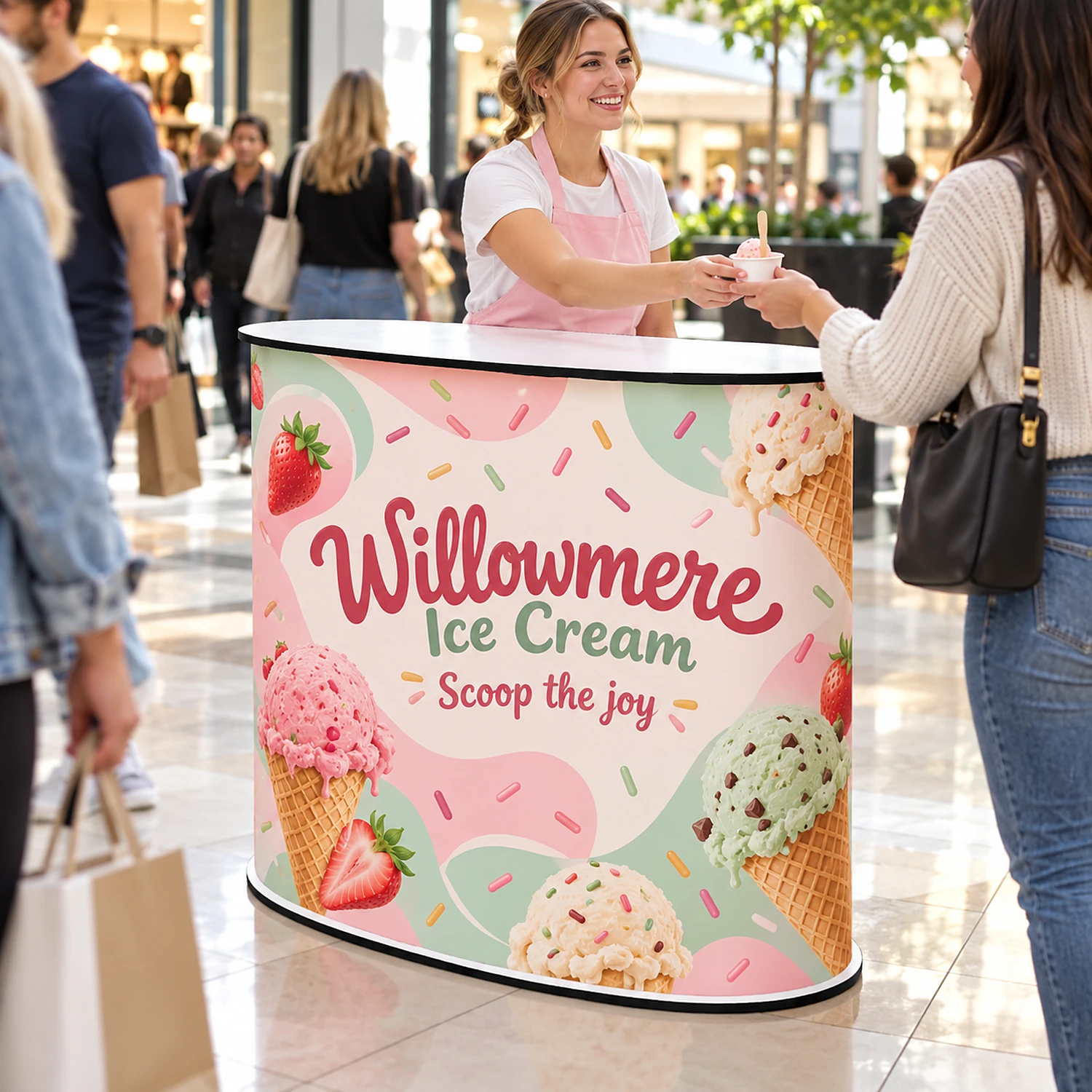
If you only need one desk for sampling, leaflets or a laptop, the same choice applies on a smaller scale. A stretch fabric rectangle counter with a rear opening is 800mm wide and 530mm deep, takes up to 35kg on the top and has room inside for stock (£243.95). The Basics curved promotional counter is 900mm wide and 470mm deep with an opening at the back for storage (£258.95). The stretch fabric oval counter is the most compact at 595mm by 395mm and 6kg (£182.95), but it is fully enclosed with nothing stored inside.
A fabric pop-up counter is another straight-fronted option. It is a 1065mm wide, 400mm deep box on a pop-up frame with a fabric wrap and a top that takes up to 25kg (£327.95), and it sets up in a few minutes. Browse all our pop up counters if you like that style.
For a small promotion I would pick the oval when space is tight and you have nothing to keep inside, the curved one when you want the softer look with somewhere for bags and spare stock, and the rectangle when you need the most top surface for the money.
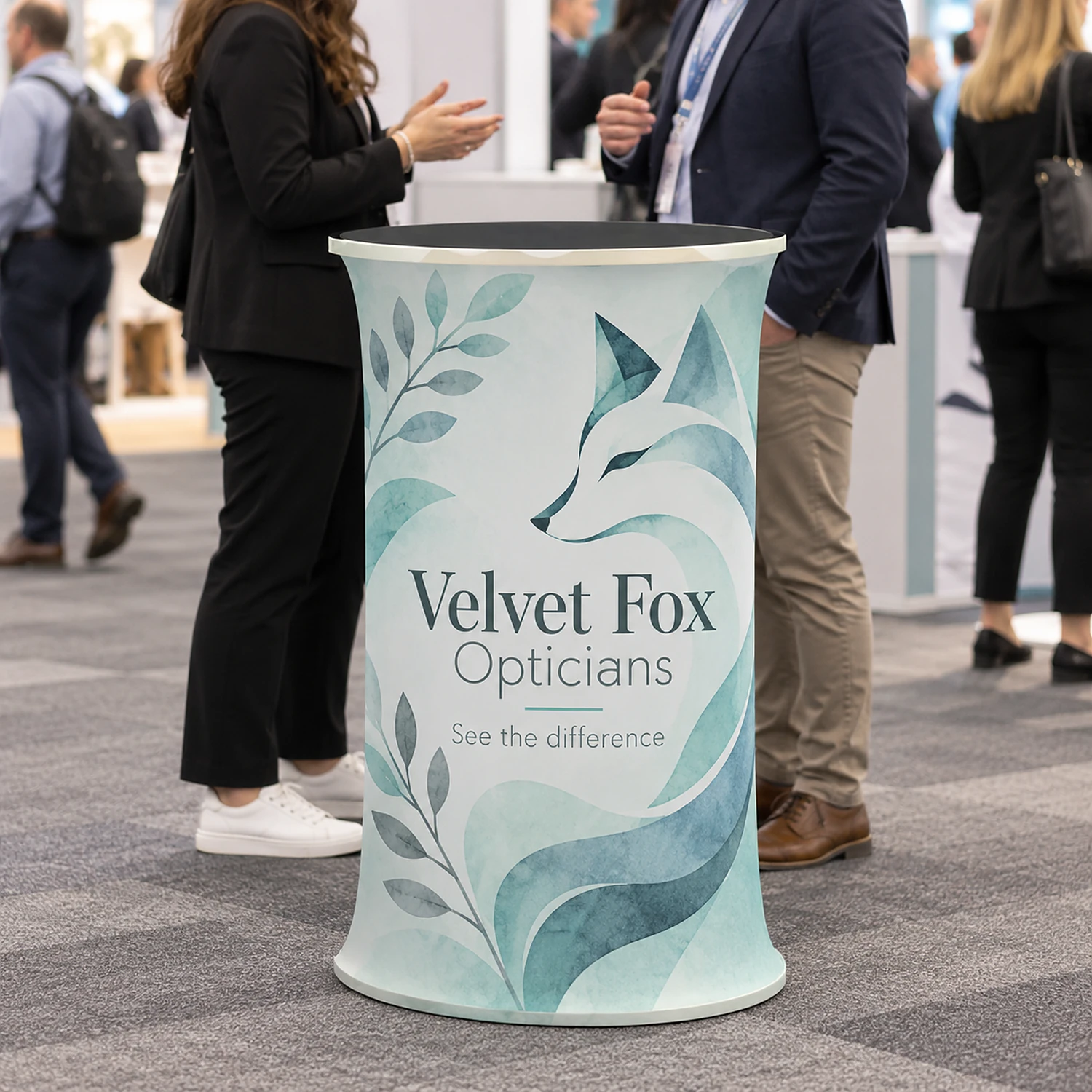
Which shape should you buy for a professional display
- Choose a straight desk if your plot is 3m deep or less, it runs along an aisle or wall, or you want a formal reception or registration point.
- Choose a convex curve if your exhibit is open on two or more sides and you want people to approach from different angles.
- Choose a concave curve for demos and conversations where a small group faces one person.
- Choose a compact oval or small curved counter if you want a branded point on a small promotional pitch.
You can see every model in our exhibition counters range, with the curved ones grouped so you can compare each curved exhibition counter side by side, and the stretch styles under fabric counters. If the desk is mainly for welcoming people, my guide to the best reception counter for events goes into more detail, and if this is your first show, see the best exhibition stand for a first trade show.
Frequently asked questions
Is a curved counter more expensive than a straight one?
Not by much. In our InfoDesk range the 1.74m convex curve is £6 cheaper than the straight model, and at about 2.3m the curved versions cost £38 to £51 more. Size affects the price more than shape.
Does a curved counter take up more room?
Yes. Depending on width, our curved models in that range are 683mm to 1097mm deep against 488mm for every straight one, so allow for the extra depth in your layout.
What height should an exhibition counter be?
Most of ours are about 1m high, which is a comfortable standing height for talking to people and writing on the top. The curved and straight models in the same range share the same height.
Can I use a curved counter with straight walls?
Yes. A curved desk in front of a straight back wall is a common layout, and it softens the look. Just keep a clear walkway behind it for your staff.